


How To Compare Custom Skid System Suppliers Beyond Price Alone
2026-05-20 22:421. Compare Engineering Capability, Not Only Product Lists
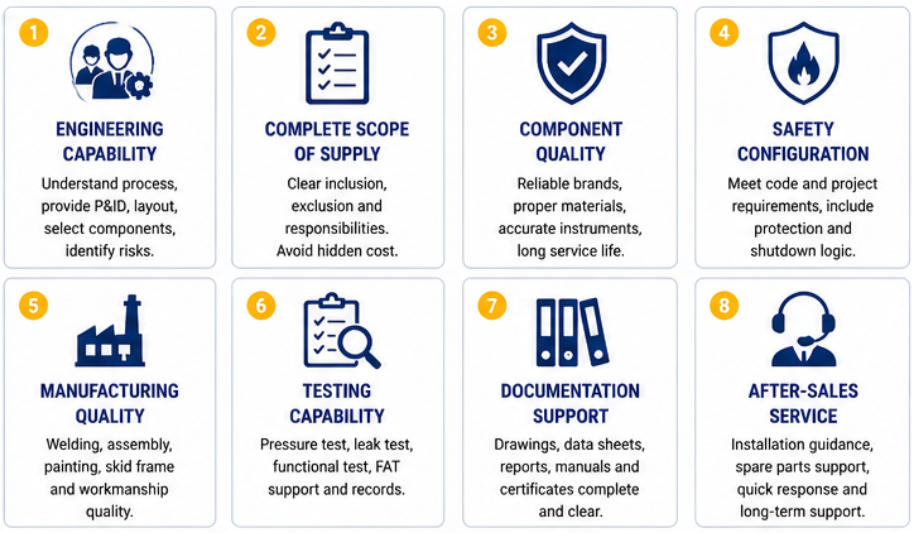
A custom skid system is not a standard off-the-shelf product. The supplier must understand working conditions, process requirements, safety logic, pressure control, flow measurement, material selection, layout design, and factory testing. This is why engineering capability should be the first comparison point.
A professional supplier should be able to review the buyer’s process data, ask technical questions, recommend a suitable configuration, provide P&ID, prepare general arrangement drawings, explain component selection, and identify possible risks before production.
If a supplier only provides a quick price without reviewing pressure, temperature, flow range, medium, safety requirements, and control logic, the quotation may not be reliable for a real industrial project.
Engineering Capability Checklist
| Capability | What Buyers Should Check |
|---|---|
| Process Understanding | Can the supplier understand pressure, flow, temperature, medium, and process application? |
| P&ID Support | Can the supplier provide or review piping and instrumentation diagrams? |
| Layout Design | Can the supplier design skid layout, maintenance access, and interface direction? |
| Risk Review | Can the supplier identify missing data, safety issues, and installation risks early? |
2. Compare Complete Scope Of Supply
Many supplier quotations look similar at first glance, but the actual scope may be very different. One supplier may include valves, regulators, instruments, safety devices, control cabinet, skid frame, testing, documents, and packing. Another supplier may only include a basic mechanical assembly.
Buyers should request a clear scope of supply and exclusion list. This makes it easier to compare suppliers fairly and avoids unexpected extra cost after order confirmation.
A complete proposal should clearly state what is included, what is optional, what is excluded, and what the buyer or site contractor must prepare locally.
Scope Items To Compare
| Scope Category | Typical Items |
|---|---|
| Mechanical Package | Piping, valves, filters, regulators, flow meters, fittings, flanges, skid frame. |
| Safety Devices | Safety shut-off valve, relief valve, monitor regulator, safety valve, vent line, emergency shut-off. |
| Instrumentation | Pressure gauges, transmitters, temperature sensors, flow instruments, alarms. |
| Control System | Control cabinet, wiring, terminal box, signal output, PLC or remote monitoring interface. |
| Documents And Tests | Drawings, data sheets, pressure test, leak test, FAT report, manuals, packing list. |
3. Compare Component Quality And Brand Transparency
The quality of a skid system depends heavily on its key components. Regulators, control valves, safety valves, flow meters, transmitters, actuators, positioners, filters, control cabinet components, and sealing materials all affect long-term reliability.
Buyers should ask suppliers to provide a main component list with brand, model, material, pressure rating, accuracy class, and technical data where applicable. If the supplier is unwilling to clarify component details, it may be difficult to judge whether the quotation is truly competitive.
Price differences often come from component differences. A higher quotation may include better valves, certified instruments, stronger control cabinet configuration, or more complete safety protection. These differences should be reviewed before choosing a supplier.
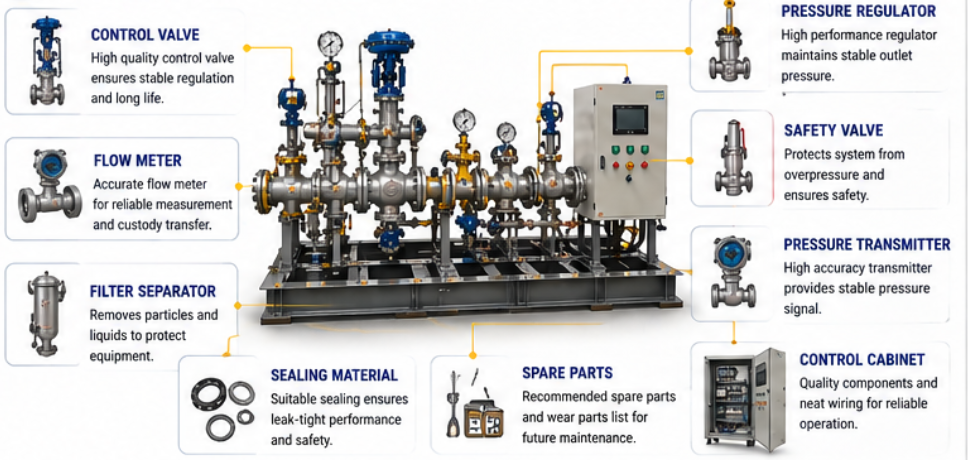
Component Information Buyers Should Request
Main valve brand, model, material, and pressure rating
Regulator or control valve sizing basis
Flow meter type, accuracy, and calibration information
Pressure and temperature transmitter specifications
Safety device configuration and set points
Control cabinet component list and signal interface
Sealing material and compatibility with process medium
Recommended spare parts and maintenance requirements
4. Compare Manufacturing, Testing, And Documentation Capability
Custom skid systems should be inspected and tested before shipment. Buyers should compare whether suppliers can provide pressure testing, leak testing, functional testing, instrument checks, control cabinet inspection, visual inspection, and Factory Acceptance Testing when required.
Testing capability is especially important for overseas projects because correcting problems after delivery can be expensive. A supplier with better factory inspection and documentation processes can help reduce site installation and commissioning risk.
Documentation is also part of supplier capability. A reliable supplier should provide P&ID, general arrangement drawing, component list, valve data sheets, instrument data sheets, test reports, FAT report, operation manual, maintenance instructions, packing list, and as-built drawings when required.
| Capability | What To Compare |
|---|---|
| Manufacturing Quality | Welding, assembly, painting, labeling, pipe support, skid frame quality. |
| Testing Scope | Pressure test, leak test, functional test, instrument check, control cabinet check. |
| FAT Support | Can the supplier support witness testing, video inspection, FAT report, and punch list closure? |
| Document Package | Drawings, reports, manuals, certificates, packing documents, as-built files. |
5. Compare Communication, Delivery Risk, And After-Sales Support
Good communication is important in custom skid procurement. Suppliers should respond clearly to technical questions, confirm changes in writing, update drawings when needed, and explain the impact of specification changes on price, delivery time, and system performance.
Delivery capability should also be reviewed. Buyers should compare production schedule, inspection milestones, packing method, shipping protection, lifting points, and export experience. Skid systems often include instruments and control cabinets, so transportation protection must be considered early.
After-sales support is another key factor. A reliable supplier should provide installation guidance, commissioning suggestions, spare parts support, troubleshooting support, and long-term technical communication when needed.
Practical Tip
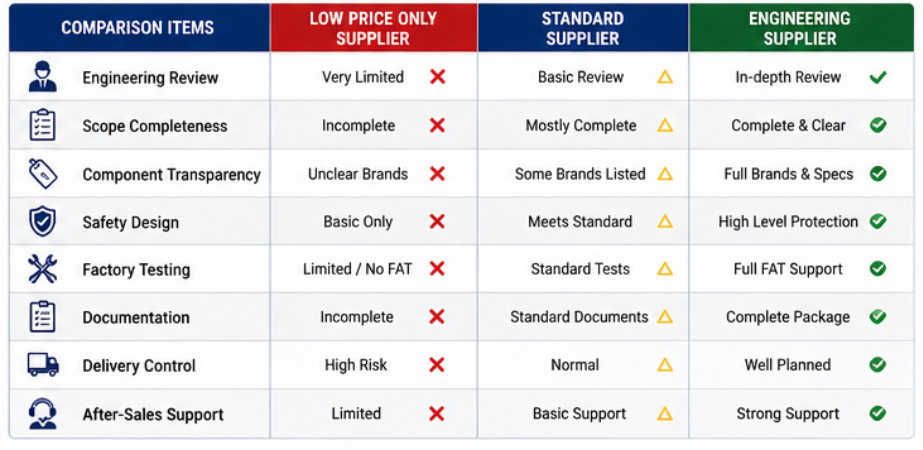
The best custom skid system supplier is not always the cheapest one. It is the supplier that can reduce engineering risk, provide a complete scope, control quality, document the process, and support the project after delivery.
Final Supplier Comparison Checklist
Can the supplier understand and review the working conditions?
Does the quotation include a complete scope of supply?
Are key component brands and specifications clearly listed?
Can the supplier provide P&ID and general arrangement drawings?
Are safety devices, instruments, and control requirements included?
Can the supplier perform pressure test, leak test, and functional inspection?
Can the supplier provide FAT report, test documents, and operation manual?
Does the supplier have export packing and delivery experience?
Can the supplier support installation, commissioning, and spare parts?
Conclusion
Comparing custom skid system suppliers beyond price alone helps buyers reduce procurement risk and avoid hidden costs. Price is important, but it should be evaluated together with engineering capability, scope completeness, component quality, safety configuration, manufacturing quality, testing capability, documentation, delivery control, and after-sales support.
For industrial projects, the right supplier should provide more than equipment. They should provide an engineered solution that supports safe operation, stable performance, easier installation, and reliable long-term maintenance.
FAQ
Why should buyers not compare skid system suppliers only by price?
Because a lower price may exclude important components, safety devices, instruments, testing, documents, or engineering support, which can increase project risk later.
What is the most important factor when choosing a custom skid supplier?
Engineering capability is one of the most important factors because custom skid systems must match real process conditions and project requirements.
What documents should a reliable supplier provide?
A reliable supplier should provide technical proposal, P&ID, general arrangement drawing, component list, data sheets, test reports, operation manual, and packing documents.
How can buyers identify hidden cost in a quotation?
Buyers should compare the complete scope of supply, exclusions, component brands, testing scope, documentation, packing, and after-sales support.
Need A Reliable Custom Skid System Supplier?
Send us your medium, pressure range, flow data, control requirements, site layout, and project standards. Our engineering team can help you review the working conditions and provide a suitable custom skid system solution.
Get Quote Contact Us