

What Buyers Should Know About Factory Acceptance Testing For Skid Systems
2026-05-19 22:381. Why Factory Acceptance Testing Matters For Skid Systems
A skid system is usually a custom-engineered package. It may include valves, regulators, filters, flow meters, pressure transmitters, temperature sensors, control cabinet, piping, skid frame, drain points, vent points, wiring, instruments, and safety devices. Because so many components are integrated together, small errors can create major problems after the skid arrives at the project site.
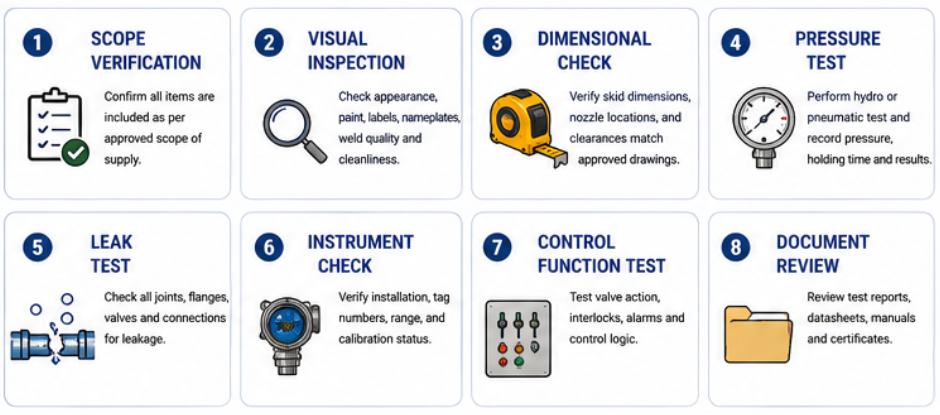
FAT gives buyers an opportunity to check the skid before shipment. It helps confirm that the physical equipment matches the approved drawings, the main components match the agreed scope, the pressure-bearing parts are tested, the instruments are installed correctly, and the required documents are complete.
For overseas projects, FAT is even more valuable because correcting problems after shipment can be expensive and time-consuming. A well-planned FAT process can reduce site risk and improve confidence before delivery.
Main Purposes Of FAT
| FAT Purpose | What It Helps Confirm |
|---|---|
| Scope Verification | Confirms that valves, instruments, skid frame, piping, and accessories are included as agreed. |
| Assembly Quality | Checks component installation, labels, orientation, supports, and workmanship. |
| Pressure And Leak Testing | Verifies pressure resistance and sealing performance before shipment. |
| Document Review | Ensures drawings, test reports, manuals, and certificates are ready. |
2. What Should Be Checked Before FAT Starts
Before FAT starts, buyers should confirm the approved technical documents. These usually include the final P&ID, general arrangement drawing, component list, valve data sheets, instrument list, electrical wiring diagram when applicable, inspection and test plan, and agreed acceptance criteria.
Buyers should also clarify what tests will be performed during FAT. For some skid systems, FAT may include only visual inspection, dimensional checking, pressure test, leak test, and document review. For more complex skids, it may also include instrument signal check, control cabinet inspection, valve action test, alarm simulation, interlock function check, and communication interface verification.
If the buyer requires video inspection, third-party inspection, witness testing, photo records, or special report format, these requirements should be confirmed before the FAT date.
Documents To Prepare Before FAT
Approved P&ID
Approved general arrangement drawing
Final scope of supply
Main component list
Valve and instrument data sheets
Electrical wiring diagram when applicable
Inspection and test plan
Acceptance criteria and reporting format
3. Key FAT Items For Mechanical And Piping Inspection
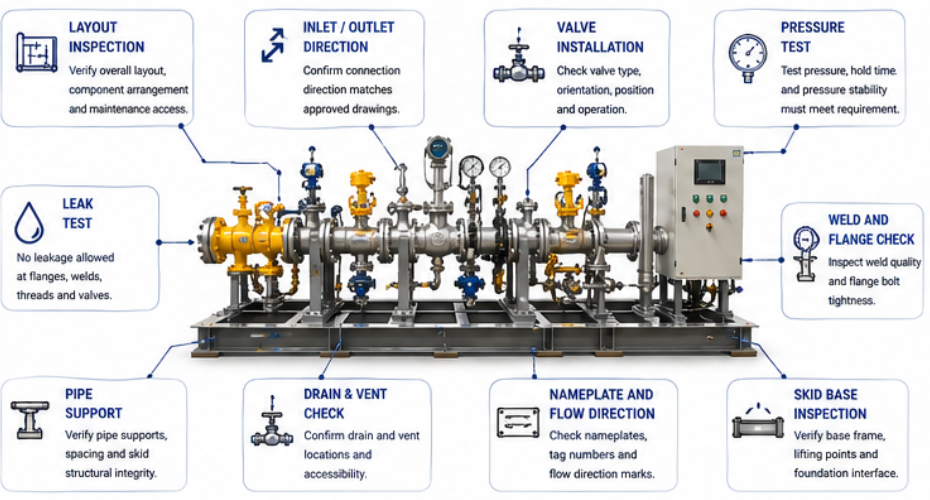
Mechanical and piping inspection is the basic part of FAT for most skid systems. Buyers should check whether the skid matches the approved layout, whether the inlet and outlet direction is correct, whether the valves and instruments are installed in the correct positions, and whether enough maintenance space is available.
Pressure test and leak test are also important. These tests confirm that pressure-bearing parts, flanges, welds, threaded connections, valves, and fittings can withstand the required test conditions and remain sealed. The test pressure, test medium, holding time, and acceptance criteria should be clearly recorded.
Buyers should also check painting, coating, nameplates, flow direction marking, drain and vent arrangement, pipe supports, lifting points, skid base quality, and packing preparation.
Mechanical FAT Checklist
| Inspection Item | What To Check |
|---|---|
| Layout Inspection | Skid dimensions, inlet/outlet direction, component arrangement, and maintenance access. |
| Pressure Test | Test pressure, holding time, pressure stability, and pressure-bearing integrity. |
| Leak Test | Flanges, welds, valves, threaded connections, and instrument connections. |
| Visual Inspection | Painting, labels, nameplates, flow direction marks, supports, and surface finish. |
4. Instrument, Control, And Safety Function Checks
For skid systems with instruments and automation, FAT should include instrument and control checks. Pressure transmitters, temperature sensors, flow meters, switches, actuators, positioners, solenoid valves, control cabinet, alarm signals, and communication interfaces may all need verification depending on project scope.
Buyers should check whether instrument tags match the P&ID, whether wiring is neat and labeled, whether signal output is correct, and whether local display or control cabinet functions work as required. For safety-related functions, alarm points, shutdown logic, valve action, and fail-safe positions should be checked according to the agreed control philosophy.
Not every FAT can fully simulate real operating conditions, especially for steam or gas systems. However, signal checks, valve action checks, continuity checks, and control logic simulation can still identify many problems before shipment.
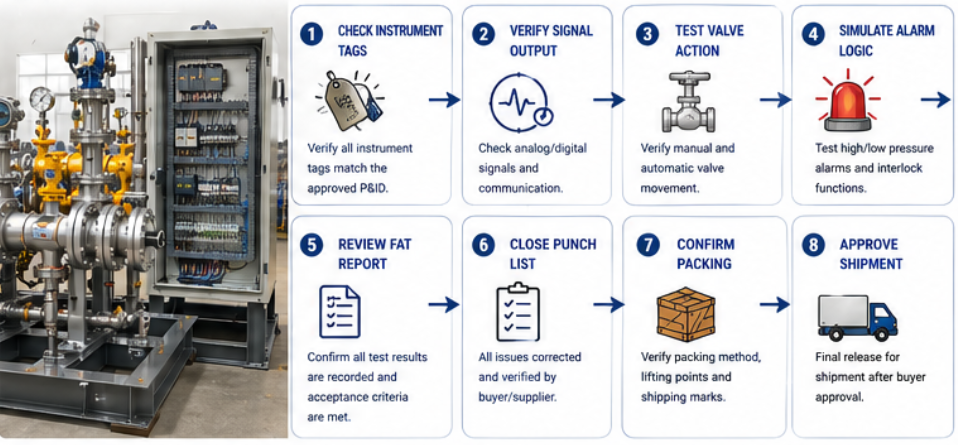
Control FAT Checklist
Instrument tag numbers match the P&ID.
Pressure and temperature instruments are installed in correct locations.
Signal output and wiring terminals are checked.
Actuator and positioner movement is verified.
Alarm points are checked according to the control philosophy.
Emergency shutdown or safety interlock logic is tested when required.
Control cabinet layout, wiring, labels, and power supply are inspected.
Remote monitoring or communication interface is confirmed when included.
5. FAT Report, Punch List, And Final Release Before Shipment
After FAT is completed, the supplier should provide a clear FAT report. The report should include inspection items, test conditions, test results, photos, pressure test records, leak test records, instrument check records, non-conformity items if any, and final conclusion.
If there are issues found during FAT, they should be listed in a punch list. The punch list should include each issue, corrective action, responsible party, completion status, and final verification. Buyers should not release the skid for shipment until all critical issues are closed.
Before shipment, buyers should also confirm the final document package, packing method, lifting points, shipping marks, spare parts, operation manual, and as-built drawings if required.
Practical Tip
A good FAT process should end with clear evidence, not only verbal confirmation. Buyers should request photos, test records, inspection checklists, and final documents before approving shipment.
Final FAT Release Checklist
FAT report completed and signed.
Pressure test and leak test records provided.
Instrument and control check records completed.
Punch list issues closed or clearly agreed.
Final photos and nameplate information provided.
Final document package prepared.
Packing, lifting, and shipping marks confirmed.
Shipment approval released by buyer when required.
Conclusion
Factory Acceptance Testing is a key step in skid system procurement. It helps buyers verify scope, assembly quality, pressure integrity, leakage performance, instrument installation, control functions, safety logic, documents, and shipment readiness before the skid leaves the factory.
For industrial projects, a well-planned FAT process can reduce installation risk, commissioning delays, site modification, and documentation disputes. Buyers should define the FAT scope early and request clear test records, inspection reports, photos, and final documents before approving shipment.
FAQ
What is Factory Acceptance Testing for skid systems?
Factory Acceptance Testing is the inspection and testing process carried out at the manufacturer’s factory before the skid system is shipped to the project site.
What tests are usually included in FAT?
Common FAT items include visual inspection, dimensional inspection, pressure test, leak test, instrument check, control function check, document review, and final photo record.
Does FAT replace site commissioning?
No. FAT reduces factory-side risks before shipment, but final commissioning is still required after installation under real site conditions.
Why is a punch list important?
A punch list records issues found during FAT and tracks corrective actions before final shipment approval.
Need A Tested And Documented Skid System?
Send us your skid system requirements, working conditions, inspection needs, and documentation standards. Our engineering team can help you prepare a suitable skid-mounted solution with clear testing and documentation support.
Get Quote Contact Us