



How To Choose A Gas Metering And Regulating Skid For Industrial Projects
2026-05-18 22:341. Confirm Gas Medium, Pressure, And Flow Conditions
The first step in selecting a gas metering and regulating skid is to confirm the real working conditions. The supplier needs to know the gas medium, inlet pressure range, required outlet pressure, maximum flow, normal flow, minimum flow, gas temperature, pipe size, connection standard, and installation environment.
Many procurement problems happen when the skid is quoted only by nominal pipe diameter or rough flow value. In real industrial operation, gas demand may change between startup, normal production, peak load, and standby conditions. If the regulator or flow meter is not correctly sized, the system may suffer from unstable outlet pressure, inaccurate metering, high pressure loss, regulator hunting, or insufficient flow capacity.
Buyers should provide the full flow range instead of only one design flow value. Minimum flow is especially important for metering accuracy, while maximum flow determines whether the skid can meet peak demand without excessive pressure drop.
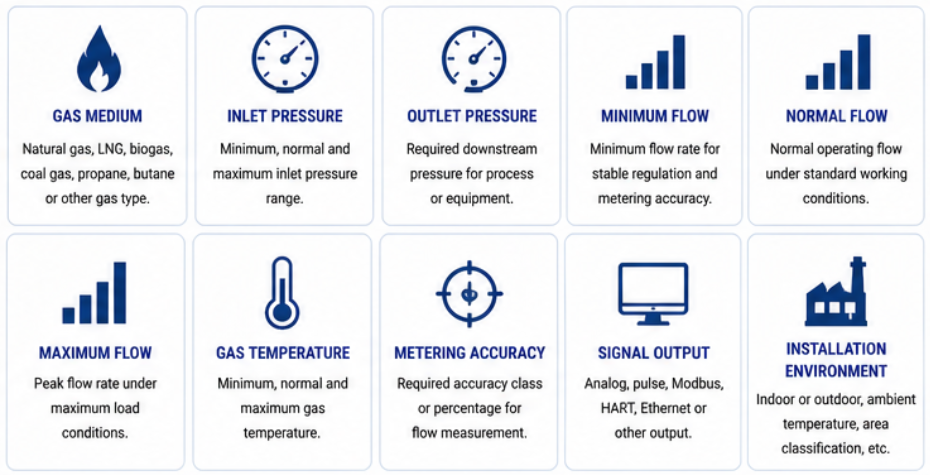
Key Data Buyers Should Provide
| Required Data | Why It Matters |
|---|---|
| Gas Medium | Affects material selection, sealing, filtration, safety design, and metering method. |
| Inlet Pressure Range | Determines pressure class, regulator sizing, and safety protection design. |
| Outlet Pressure Requirement | Defines downstream process pressure and regulator control target. |
| Flow Range | Ensures accurate metering and stable regulation at minimum, normal, and peak flow. |
| Installation Environment | Affects skid layout, corrosion protection, instrument enclosure, and maintenance access. |
2. Review Metering Accuracy And Flow Meter Selection
The metering section is one of the most important parts of a gas metering and regulating skid. It is used to measure gas consumption, process flow, custody transfer data, energy usage, or production demand. The flow meter should be selected according to gas type, flow range, pressure, temperature, accuracy requirement, pressure loss, and maintenance conditions.
Common options may include turbine flow meters, ultrasonic flow meters, vortex flow meters, orifice meters, and other gas flow measurement devices depending on the project. For industrial projects, buyers should confirm whether the metering is for internal process monitoring, billing reference, custody transfer, or energy management. Different purposes may require different accuracy levels and calibration requirements.
Metering accuracy also depends on upstream and downstream straight pipe length, flow conditioner requirements, temperature and pressure compensation, signal output, flow computer, and calibration documents. A good skid design should protect both metering accuracy and pressure control stability.
Metering Section Items To Confirm
| Metering Item | Procurement Checkpoint |
|---|---|
| Flow Meter Type | Should match gas medium, flow range, accuracy target, and operating pressure. |
| Accuracy Requirement | Internal monitoring and custody transfer may require different accuracy levels. |
| Straight Pipe Length | Affects flow profile and measurement accuracy. |
| Pressure And Temperature Compensation | Improves corrected flow calculation and data reliability. |
| Signal Output | Confirms connection with PLC, flow computer, SCADA, or plant control system. |
3. Check Pressure Regulation Design And Safety Devices
The regulating section reduces and stabilizes gas pressure before gas enters downstream equipment. Depending on inlet pressure, outlet pressure, pressure ratio, flow range, and process importance, the skid may use single-stage regulation, two-stage regulation, monitor regulator design, or one working line plus one standby line.
For industrial gas projects, safety devices should be reviewed together with pressure regulation. A typical skid may include safety shut-off valve, relief valve, monitor regulator, pressure gauge, pressure transmitter, gas leak detector, emergency shut-off valve, vent line, and alarm output depending on project requirements.
Buyers should not only ask whether the skid includes a regulator. They should check how the system responds to overpressure, underpressure, regulator failure, sudden flow change, filter blockage, or emergency shutdown.
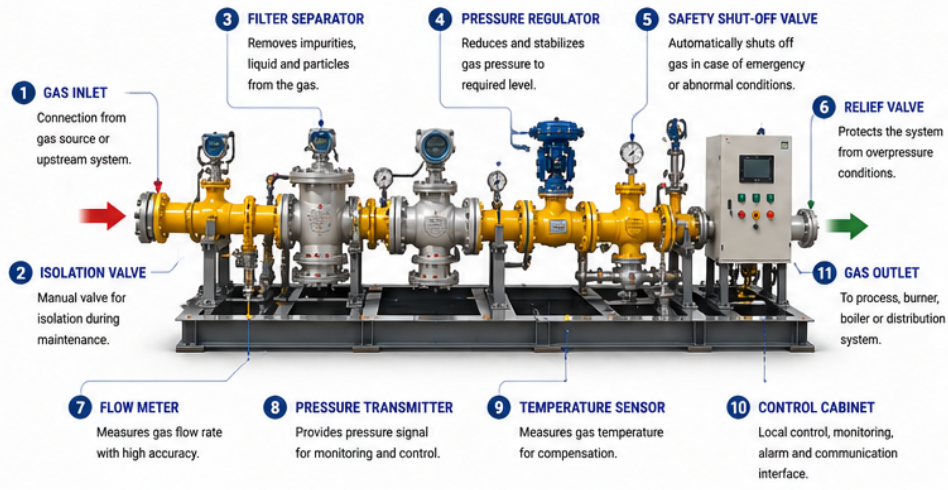
Common Components In A Gas Metering And Regulating Skid
| Component | Function |
|---|---|
| Filter Separator | Removes particles and liquid impurities before regulation and metering. |
| Pressure Regulator | Reduces inlet gas pressure to the required outlet pressure. |
| Flow Meter | Measures gas flow for process monitoring, billing, or energy management. |
| Safety Shut-Off Valve | Automatically isolates gas flow during abnormal pressure conditions. |
| Pressure Transmitter | Provides pressure data for monitoring, alarms, and control system integration. |
4. Evaluate Skid Layout, Maintenance Access, And System Integration
A gas metering and regulating skid should be easy to install, inspect, operate, and maintain. Layout is important because the skid includes multiple functional sections: filtration, regulation, metering, safety protection, instrumentation, control cabinet, drain or vent points, and bypass lines when required.
Buyers should confirm the skid footprint, inlet and outlet direction, flange standard, lifting points, foundation requirements, operation space, and maintenance access. Flow meters may require straight pipe sections or flow conditioning, while regulators and filters need enough space for inspection and replacement.
For automated industrial projects, the skid may also need signal output, local display, control cabinet, alarm system, remote monitoring module, or SCADA interface. These requirements should be confirmed before quotation so the supplier can include the correct instruments and wiring scope.
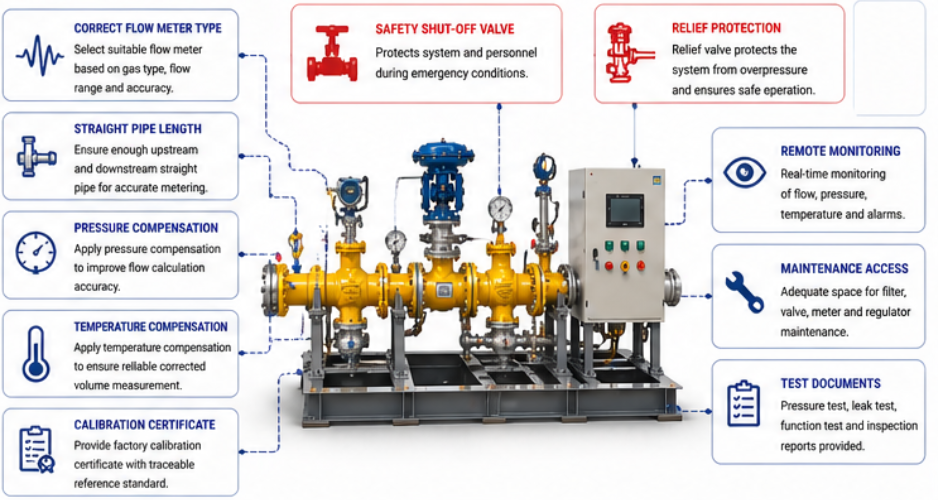
Layout And Integration Checklist
Confirm skid footprint and available installation space.
Check inlet and outlet direction before fabrication.
Confirm flow meter straight pipe and maintenance access requirements.
Review filter maintenance space and drainage arrangement.
Check regulator, shut-off valve, and relief valve accessibility.
Confirm pressure and temperature instrument locations.
Review control cabinet position and wiring route.
Confirm signal output, alarm, and remote monitoring requirements.
5. Confirm Testing, Calibration, And Documentation
Testing and documentation are essential for gas metering and regulating skid procurement. Before shipment, the supplier should check assembly quality, pressure resistance, leakage, valve action, instrument installation, metering section configuration, control cabinet wiring, and final skid layout.
Depending on project requirements, buyers may request pressure test report, leak test report, functional test record, flow meter calibration certificate, material certificate, instrument data sheet, valve data sheet, P&ID, general arrangement drawing, operation manual, and packing information.
For industrial projects where metering accuracy is important, calibration and traceability should be confirmed early. If the skid is used for custody transfer or billing-related metering, the documentation and accuracy requirements may be stricter.
Practical Tip
A good gas metering and regulating skid should provide stable pressure and reliable flow measurement at the same time. Do not evaluate the regulator and flow meter separately. The complete skid should be reviewed as one integrated system.
Final Procurement Checklist
Confirm gas medium, inlet pressure, outlet pressure, and flow range.
Define metering purpose and required accuracy.
Select suitable flow meter type and signal output.
Review pressure regulation design and safety protection logic.
Confirm filter, regulator, meter, valve, and instrument scope.
Check skid layout, maintenance access, and interface direction.
Request pressure test, leak test, functional test, and calibration documents.
Review P&ID, general arrangement drawing, manuals, and packing information.
Conclusion
Choosing a gas metering and regulating skid for industrial projects requires a complete review of gas conditions, metering accuracy, regulator design, safety devices, instruments, layout, testing, calibration, and documentation. A reliable skid should not only reduce pressure but also measure gas flow accurately and protect downstream equipment.
For buyers, the safest procurement approach is to provide complete working conditions and compare suppliers by system engineering capability, not price alone. A well-designed skid can improve pressure stability, metering reliability, installation efficiency, and long-term operational safety.
FAQ
What is a gas metering and regulating skid?
It is a skid-mounted system used to filter, regulate, measure, monitor, and protect gas flow in industrial gas supply projects.
What information is needed before quotation?
Buyers should provide gas medium, inlet pressure, outlet pressure, flow range, metering accuracy requirement, installation environment, and control requirements.
How do I choose the right flow meter?
The flow meter should be selected according to gas type, flow range, pressure, temperature, required accuracy, pressure loss, signal output, and maintenance conditions.
What safety devices are usually included?
Common safety devices include safety shut-off valve, relief valve, monitor regulator, pressure transmitter, pressure gauge, vent line, gas leak detector, and emergency shut-off valve when required.
Need A Gas Metering And Regulating Skid For Your Project?
Send us your gas medium, pressure range, flow data, metering accuracy requirement, site layout, and project conditions. Our engineering team can help you review the working conditions and provide a suitable gas metering and regulating skid solution.
Get Quote Contact Us