


How To Reduce Noise And Vibration In Steam Pressure Reducing Systems
2026-05-17 22:301. Understand Why Noise And Vibration Happen
Noise and vibration in steam pressure reducing systems are usually caused by high pressure drop, high steam velocity, incorrect valve sizing, unsuitable valve trim, poor piping layout, rapid load changes, or unstable control valve movement. In many cases, several factors happen at the same time.
When high-pressure steam passes through a valve opening, steam velocity increases sharply. If the pressure drop is too large for a basic valve design, the system may generate strong aerodynamic noise and vibration. This can lead to pipe stress, loose connections, instrument failure, valve trim wear, and reduced equipment life.
The first step is to identify whether the problem comes from valve selection, excessive pressure drop, poor control response, unstable flow, weak pipe support, or site layout. A good design should reduce noise and vibration at the engineering stage rather than trying to fix them after commissioning.
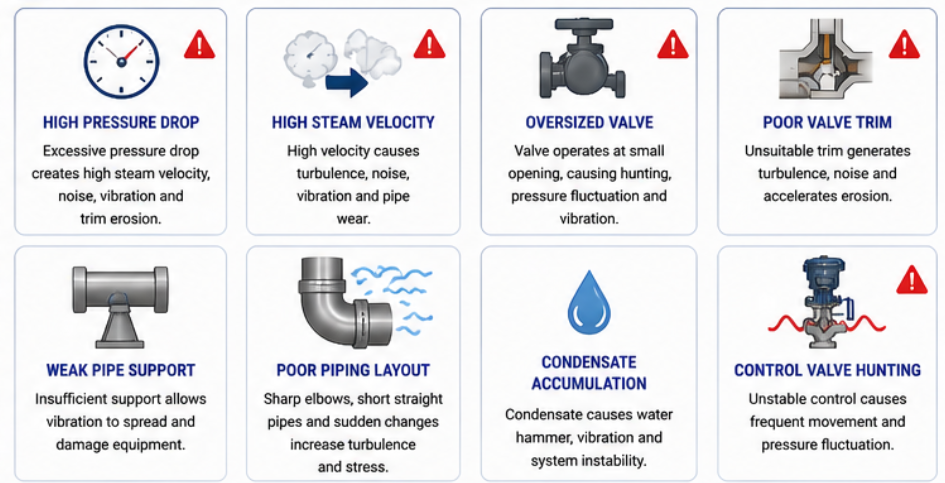
Common Causes To Check
| Cause | Possible Result |
|---|---|
| High Pressure Drop | Creates high steam velocity, noise, vibration, and trim erosion. |
| Oversized Valve | Causes poor low-flow control, valve hunting, and pressure fluctuation. |
| Poor Piping Layout | Increases turbulence, stress, and unstable measurement signals. |
| Weak Pipe Support | Allows vibration to spread and damage instruments or joints. |
2. Select The Right Control Valve And Valve Trim
The control valve is the main source of pressure reduction, so valve selection has a direct impact on noise and vibration. A valve should not be selected only by pipe size. It should be sized according to inlet pressure, outlet pressure, steam temperature, minimum flow, normal flow, maximum flow, pressure drop, and control accuracy.
If the pressure drop is high, a standard valve trim may not be enough. The system may require multi-stage pressure reduction trim, low-noise trim, cage-guided trim, anti-erosion materials, or a specially designed severe-service valve. These designs help divide the pressure drop into smaller steps and reduce steam velocity inside the valve.
Buyers should ask the supplier to provide valve sizing basis, Cv value, valve opening range, trim type, actuator type, and noise control considerations. This is especially important for boiler rooms, power plants, chemical plants, and continuous process lines where steam pressure stability is critical.
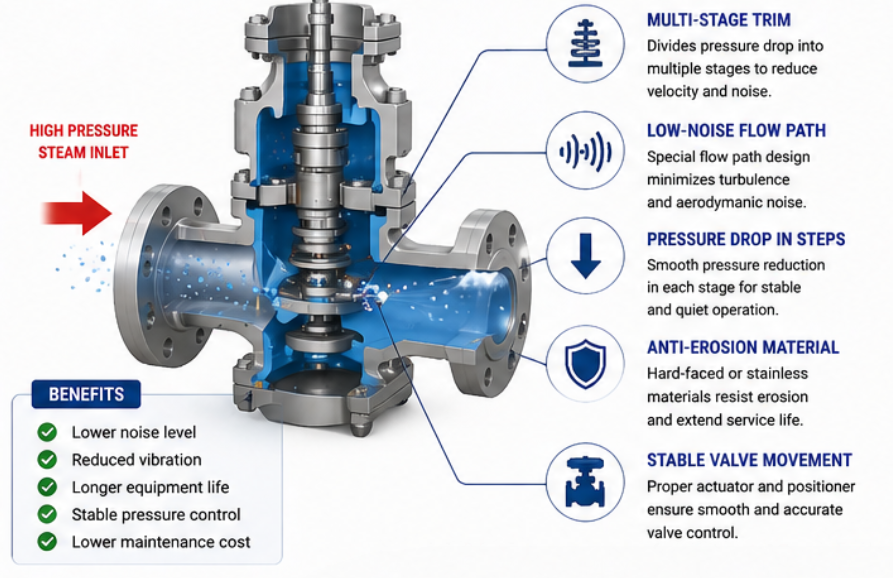
Valve Selection Measures For Noise Reduction
Use correct valve sizing based on actual steam flow range.
Avoid oversized valves that operate at very small openings.
Use low-noise trim for high pressure drop applications.
Consider multi-stage trim to reduce steam velocity step by step.
Select suitable actuator and positioner for stable valve movement.
Check valve material and trim material for erosion resistance.
Review the expected noise level during engineering selection.
3. Optimize Piping Layout And Flow Path
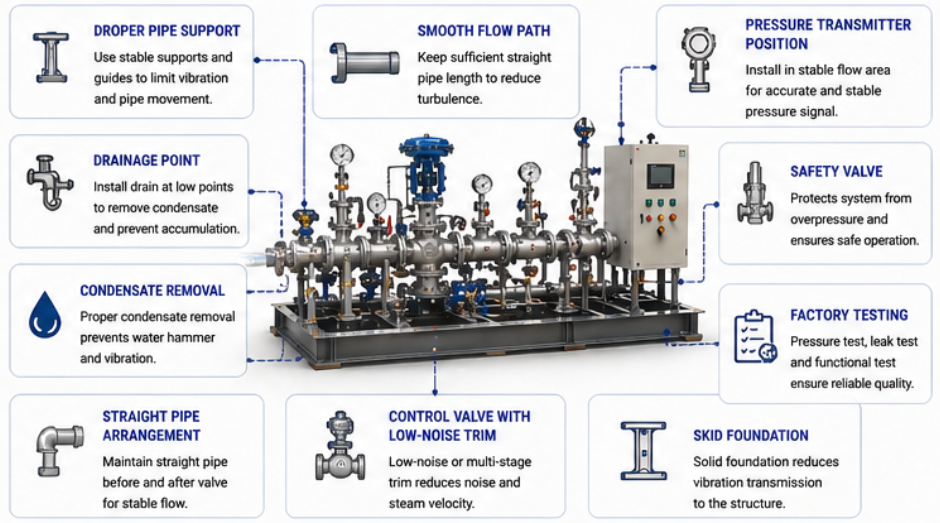
Piping layout has a major influence on system vibration. Sharp elbows, sudden diameter changes, short straight pipe sections, poor support positions, and improper instrument locations can increase turbulence and pressure fluctuation. A well-designed steam pressure reducing skid should create a stable flow path before and after the pressure reducing valve.
The outlet side of the control valve is especially important because steam velocity may be high after pressure reduction. If downstream piping is too short or poorly arranged, noise and vibration may be amplified. Proper pipe diameter, reducer design, straight pipe length, and support structure can help reduce these risks.
For skid-mounted systems, the layout should be reviewed before fabrication. Buyers should check inlet and outlet direction, valve position, pressure transmitter location, safety valve arrangement, drain points, pipe supports, and maintenance access.
Piping Design Points To Review
| Design Point | How It Helps |
|---|---|
| Smooth Flow Path | Reduces turbulence and pressure fluctuation. |
| Proper Pipe Support | Limits vibration and protects valves, instruments, and joints. |
| Correct Instrument Position | Improves signal stability and control response. |
| Suitable Outlet Pipe Size | Controls steam velocity after pressure reduction. |
4. Control Condensate, Drainage, And Desuperheating Effects
Noise and vibration can also be caused by condensate accumulation, water hammer, and poor desuperheating performance. Steam lines should include proper drain points, vent points, and startup drainage design. Condensate should not accumulate near the pressure reducing valve, control valve, or downstream pipeline.
If the system includes desuperheating, spray water atomization must be properly controlled. Large water droplets or excessive spray water can create wet steam, pipe erosion, unstable temperature control, and water hammer. The desuperheater, spray water control valve, temperature sensor, and downstream straight pipe length should be reviewed together.
Proper drainage and desuperheating design help protect the steam pressure reducing system and improve long-term operating stability.
Drainage And Desuperheating Checklist
Confirm drain points before and after the pressure reducing section.
Check whether condensate can be safely removed during startup.
Review vent points and maintenance access.
Confirm spray water pressure and atomization quality if desuperheating is included.
Check downstream straight pipe length after the desuperheater.
Install temperature sensors in suitable positions.
Avoid wet steam entering sensitive downstream equipment.
5. Verify The System Through Testing And Commissioning
Factory inspection and site commissioning are important for reducing noise and vibration risk. Before shipment, the steam pressure reducing skid should be checked for assembly quality, pressure resistance, leakage, valve operation, instrument installation, pipe support condition, and control cabinet wiring when applicable.
During commissioning, operators should monitor outlet pressure stability, valve opening range, vibration level, noise level, instrument signal stability, and drain performance. If the control valve hunts or the pressure fluctuates, the control loop may need tuning.
A good supplier should provide drawings, valve data sheets, test reports, operation manuals, and commissioning support recommendations. These documents help buyers identify problems early and maintain stable long-term operation.
Practical Tip
If a steam pressure reducing system has high noise or vibration after installation, the root cause is often valve sizing, pressure drop, piping layout, or control instability. These issues should be reviewed before ordering, not only after startup.
Final Noise And Vibration Reduction Checklist
Provide complete inlet pressure, outlet pressure, temperature, and flow data.
Select the control valve based on actual operating range, not pipe size only.
Use low-noise or multi-stage trim for high pressure drop conditions.
Control steam velocity through proper valve and pipe sizing.
Optimize pipe layout, supports, and instrument positions.
Confirm drainage and condensate removal design.
Check desuperheating spray water atomization if included.
Request factory test records and review commissioning performance.
Conclusion
Reducing noise and vibration in steam pressure reducing systems requires a complete engineering approach. Buyers should review pressure drop, valve sizing, valve trim, actuator stability, steam velocity, piping layout, pipe supports, drainage, desuperheating performance, testing, and commissioning.
A well-designed steam pressure reducing system can provide stable pressure, lower noise, reduced vibration, longer valve life, safer operation, and lower maintenance cost. For industrial projects, these factors should be confirmed before procurement to avoid expensive site problems later.
FAQ
What causes noise in steam pressure reducing systems?
Common causes include high pressure drop, high steam velocity, incorrect valve sizing, unsuitable valve trim, and poor piping layout.
How can valve trim reduce noise?
Low-noise or multi-stage trim divides the pressure drop into smaller steps and reduces steam velocity inside the valve.
Can pipe supports reduce vibration?
Yes. Proper pipe supports help limit vibration movement and protect valves, instruments, flanges, and welded joints.
Why does drainage matter?
Good drainage prevents condensate accumulation and water hammer, both of which can create vibration and damage steam system components.
Need A Low-Noise Steam Pressure Reducing Solution?
Send us your steam pressure, temperature, flow range, pressure reduction target, and project requirements. Our engineering team can help you review valve selection, piping layout, and noise reduction design for a suitable steam pressure reducing system.
Get Quote Contact Us