


How Spray Water Pressure Affects Steam Desuperheating Performance
2026-06-29 21:52Need To Improve Steam Desuperheating Performance?
Send us your inlet steam pressure, inlet temperature, required outlet temperature, steam flow range, spray water pressure, spray water temperature, available water flow, nozzle type, temperature sensor location, and downstream pipe layout. Our engineering team can help review whether your desuperheating system or PRDS skid needs optimization.
1. Why Spray Water Pressure Matters In Desuperheating
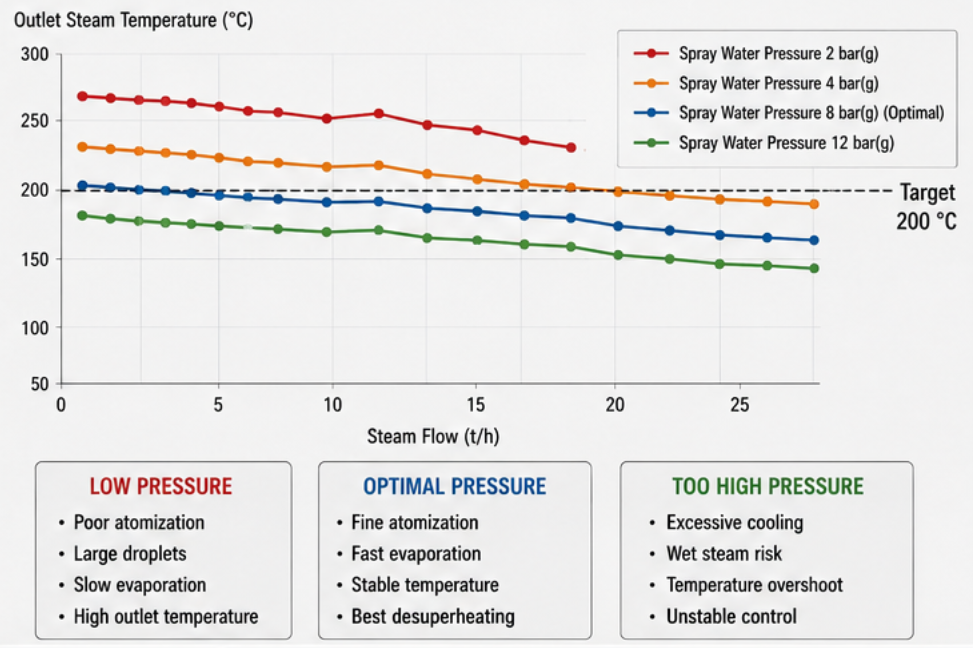
Steam desuperheating works by injecting water into superheated steam. The water must be broken into fine droplets, mixed with steam, and fully evaporated before the steam reaches downstream equipment or temperature measurement points. Spray water pressure directly affects droplet size, atomization quality, evaporation speed, and outlet temperature stability.
When spray water pressure is not suitable, the PRDS system may show high outlet temperature, unstable temperature control, wet steam, water carryover, water hammer risk, or poor response during load changes. This is why spray water conditions should be checked before judging the desuperheater or PRDS skid as a failure.
For boiler rooms, power plants, chemical plants, food processing lines, district heating systems, and industrial process steam networks, stable spray water pressure is essential for reliable temperature control.
Common Symptoms Of Spray Water Pressure Problems
Outlet steam temperature remains higher than the target value.
Outlet temperature fluctuates when steam flow changes.
Spray water valve opens widely but temperature does not drop enough.
Wet steam or water carryover appears after the desuperheater.
Temperature control becomes unstable during low-load operation.
Nozzle blockage, poor atomization, or uneven water injection is found during maintenance.
2. What Happens If Spray Water Pressure Is Too Low?
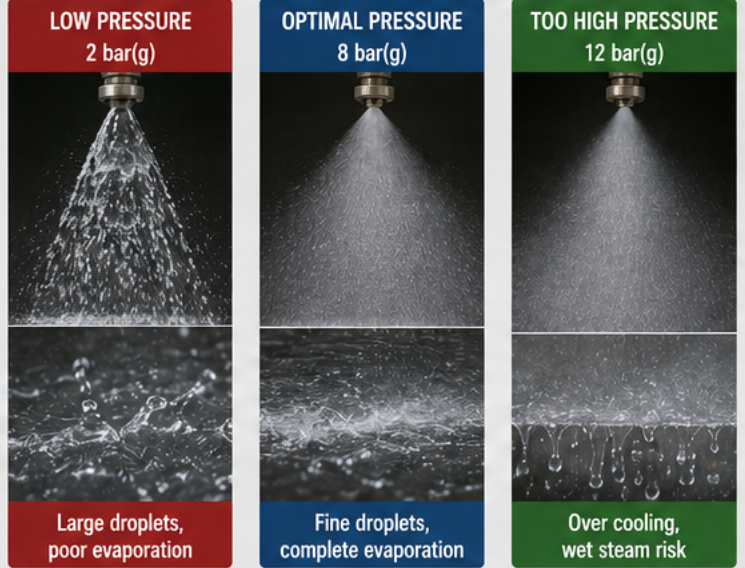
Low spray water pressure is one of the most common causes of poor desuperheating. When the water pressure is not high enough, the nozzle may not atomize water into fine droplets. Large water droplets need more time and distance to evaporate, so outlet steam temperature may remain too high or become unstable.
Low spray water pressure can also make the temperature control valve stay near a large opening while the cooling effect is still insufficient. In this case, the problem is not only valve opening. The system may need higher water pressure, correct nozzle selection, better water supply stability, or improved PRDS design.
Troubleshooting Table
| Spray Water Issue | Typical Result | What To Check |
|---|---|---|
| Low Spray Water Pressure | Poor atomization and high outlet steam temperature. | Water pressure before control valve and nozzle inlet pressure. |
| Unstable Water Pressure | Outlet temperature fluctuates during operation. | Water pump stability, pressure regulator, and water source fluctuation. |
| Insufficient Water Flow | Temperature cannot reach the setpoint at peak steam flow. | Available water flow and spray water control valve capacity. |
| Blocked Nozzle Or Filter | Uneven injection or weak spray pattern. | Nozzle holes, water filter, scale, rust, and maintenance records. |
| Wrong Nozzle Selection | Droplet size does not match steam velocity and flow range. | Nozzle type, pressure difference, steam flow, and turndown range. |
| Poor Water Quality | Nozzle scaling, blockage, and unstable performance. | Water hardness, filtration, impurities, and scaling risk. |
3. What Happens If Spray Water Pressure Is Too High?
Higher spray water pressure is not always better. If the pressure is too high but the nozzle, control valve, and control logic are not matched properly, water injection may become too aggressive. This can cause outlet temperature overshoot, wet steam, unstable control, or erosion risk in the downstream pipe.
The correct spray water pressure should be selected according to steam pressure, steam temperature, steam flow range, required outlet temperature, nozzle design, and available straight pipe length. The goal is not maximum water pressure, but stable atomization and controlled evaporation.
High Pressure Risk Checklist
Outlet temperature drops too quickly after spray water injection.
Wet steam appears after the desuperheater.
Water droplets may not evaporate before reaching elbows or equipment.
Control valve becomes difficult to modulate smoothly.
Downstream pipe erosion or water hammer risk increases.
Temperature control becomes aggressive during small load changes.
4. Spray Water Pressure Must Match Nozzle Atomization
The desuperheater nozzle is the key component that turns spray water into fine droplets. Each nozzle has a suitable pressure range. If spray water pressure is below this range, droplets become too large. If pressure is outside the design condition, the spray pattern may become poor or unstable.
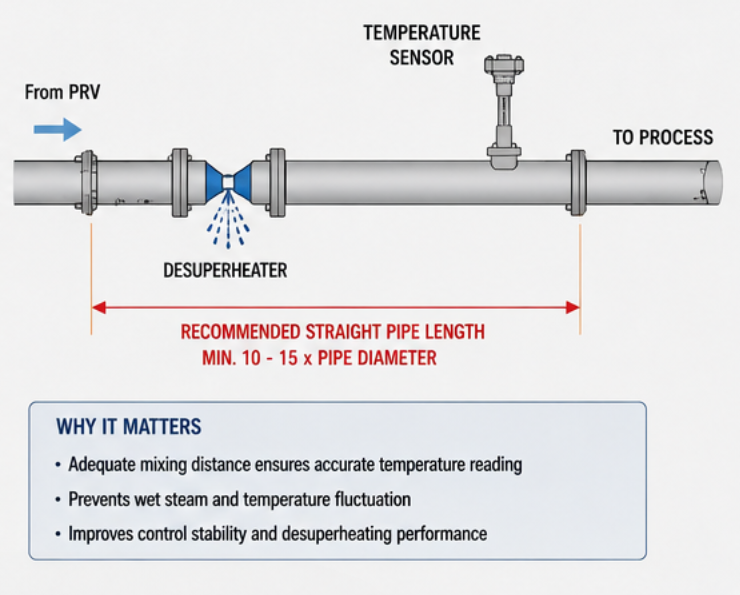
Atomization quality also depends on steam velocity, nozzle insertion position, spray direction, water flow, and mixing distance. Therefore, spray water pressure should be reviewed together with nozzle selection and downstream pipe layout.
Nozzle And Atomization Checklist
Nozzle type and design pressure range.
Spray water pressure at nozzle inlet.
Spray water flow at minimum, normal, and maximum steam load.
Steam velocity near the injection point.
Nozzle blockage, scaling, or wear condition.
Available straight pipe length for full evaporation and mixing.
5. Water Pressure Stability Is As Important As Pressure Value
Even if the spray water pressure is correct on paper, unstable water supply can still cause poor temperature control. If the water pump pressure fluctuates, if another system shares the same water source, or if the control valve receives unstable inlet pressure, outlet steam temperature may keep rising and falling.
For critical PRDS applications, spray water supply should be reviewed as part of the skid design. The system may need a stable water source, pump review, water pressure monitoring, filtration, control valve sizing, and alarm settings for low water pressure.
Water Supply Stability Checklist
Check whether spray water source is shared with other users.
Record spray water pressure during steam load changes.
Check pump capacity and pressure stability.
Review water filter pressure loss and blockage risk.
Confirm control valve inlet pressure remains stable.
Add pressure monitoring or low water pressure alarm if required.
6. How A Proper PRDS Skid Improves Spray Water Pressure Control
A properly designed PRDS skid can integrate pressure reducing valve, desuperheater, spray water control valve, spray water filter, water pressure gauge, pressure transmitter, temperature sensor, safety valve, drain valve, control cabinet, piping, supports, and skid-mounted frame into one engineered package.
Instead of treating spray water as a simple auxiliary line, the skid design should treat water pressure, water flow, nozzle atomization, temperature feedback, and steam flow range as one control system. This improves temperature stability and reduces commissioning problems.
Practical Tip
If desuperheating performance is unstable, do not only increase spray water valve opening. Check spray water pressure at the nozzle, water flow capacity, atomization quality, water source stability, nozzle condition, and temperature sensor location together.
Engineering Review Checklist
Confirm inlet steam pressure, temperature, and flow range.
Confirm required outlet steam temperature.
Check spray water pressure before valve and at nozzle inlet.
Confirm spray water flow capacity at peak steam demand.
Review nozzle type, atomization pressure, and blockage risk.
Check water quality, filtration, and scaling possibility.
Review temperature sensor location and straight pipe length.
Consider a custom PRDS skid for stable spray water and temperature control.
Conclusion
Spray water pressure directly affects steam desuperheating performance because it controls nozzle atomization, droplet size, evaporation speed, and outlet temperature stability. Low pressure may cause poor cooling and high outlet temperature, while unstable or poorly matched pressure may cause temperature fluctuation, wet steam, or control problems.
A reliable PRDS or desuperheating system should match spray water pressure, water flow, nozzle design, steam flow range, temperature sensor location, straight pipe length, and control logic together to achieve stable outlet steam temperature.
FAQ
How does spray water pressure affect steam desuperheating?
Spray water pressure affects atomization quality. Proper pressure helps create fine droplets that evaporate quickly and reduce steam temperature effectively.
What happens if spray water pressure is too low?
Low pressure may cause poor atomization, large droplets, slow evaporation, high outlet temperature, and unstable temperature control.
Is higher spray water pressure always better?
No. The pressure must match the nozzle and control design. Excessive or poorly controlled pressure may increase wet steam, overshoot, or erosion risk.
What data is needed for desuperheating system review?
Buyers should provide inlet steam pressure, inlet temperature, outlet temperature target, steam flow range, spray water pressure, spray water flow, water quality, nozzle type, sensor location, and pipe layout.
Need Help With Spray Water Pressure And Desuperheating Performance?
Send us your steam pressure, temperature, flow range, outlet temperature target, spray water pressure, water flow, nozzle condition, and pipe layout. Our engineering team can help review the working conditions and provide a suitable PRDS skid solution.
Get Quote Contact UsRelated Product Paths For This Project
How Spray Water Pressure Affects Steam Desuperheating Performance should connect the troubleshooting topic with Shenqi's real equipment categories. For gas pressure, steam pressure reducing, PRDS, skid module, valve, and prefabricated pipeline projects, buyers usually need to compare the fault symptom with the full system scope before requesting a quotation. The related pages below help the engineering team move from diagnosis to product selection without leaving the site.
- Gas Pressure Regulating Skid
- Temperature and Pressure Reducing Device
- Prefabricated Pipeline
- Skid Module
- Pressure Vessel
- Accessories
- Valves
- Contact Shenqi Machinery
For a project specific review, prepare inlet pressure, outlet pressure, flow range, medium, temperature, control accuracy, valve configuration, instrument requirement, site layout, and commissioning schedule before contacting Shenqi Machinery.