

How Spray Water Conditions Affect Steam Desuperheating Performance
2026-05-14 22:181. Why Spray Water Conditions Matter In Desuperheating
Steam desuperheating is based on heat exchange between superheated steam and injected spray water. After water is injected into the steam line, the droplets must atomize, mix with the steam, absorb heat, and evaporate completely. Only then can the outlet steam temperature become stable and suitable for downstream process use.
If the spray water pressure is too low, droplets may be too large and evaporation may be incomplete. If the spray water flow is unstable, the outlet steam temperature may fluctuate. If the water quality is poor, the nozzle may become blocked or scaled. These problems can reduce control accuracy and create long-term reliability issues.
For industrial steam systems, spray water data should be provided together with steam pressure, steam temperature, steam flow, and required outlet temperature. A complete review helps the supplier select the correct desuperheater type, nozzle structure, spray water control valve, and temperature control strategy.
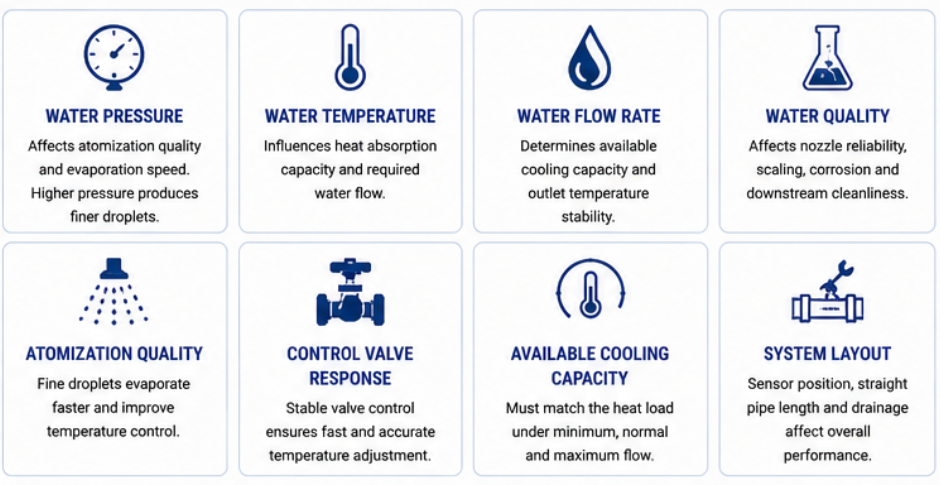
Key Spray Water Data To Confirm
| Spray Water Data | Impact On Desuperheating Performance |
|---|---|
| Water Pressure | Affects atomization quality, nozzle selection, and evaporation speed. |
| Water Temperature | Influences heat absorption and required spray water quantity. |
| Water Flow Rate | Determines whether enough cooling capacity is available. |
| Water Quality | Affects nozzle blockage, scaling, corrosion, and downstream cleanliness. |
2. Spray Water Pressure Controls Atomization Quality
Spray water pressure is one of the most important factors affecting desuperheating performance. The water must enter the steam flow with enough pressure to form fine droplets. Fine droplets have a larger contact surface area and evaporate faster, helping the system achieve stable outlet temperature.
If spray water pressure is too low, droplets may become large and heavy. These droplets may not evaporate completely before reaching the downstream pipeline or temperature sensor. This can lead to wet steam, inaccurate temperature feedback, unstable control valve movement, pipe erosion, and possible water hammer.
For some high-pressure steam applications, ordinary spray nozzles may not be enough. The system may require a special atomizing nozzle, variable-area nozzle, or steam-assisted atomization design depending on steam flow range and spray water pressure.
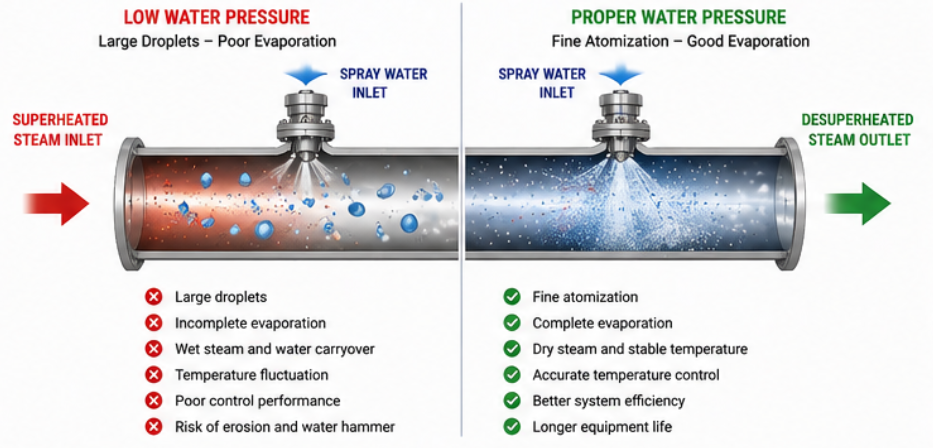
Risks Of Poor Atomization
| Problem | Possible Result |
|---|---|
| Large Water Droplets | Incomplete evaporation and wet steam downstream. |
| Unstable Spray Pattern | Outlet temperature fluctuation and poor control response. |
| Water Carryover | Pipe erosion, water hammer, and downstream equipment risk. |
| Poor Nozzle Performance | Reduced desuperheating efficiency and frequent maintenance. |
3. Water Flow And Temperature Affect Cooling Capacity
The amount of spray water must match the heat that needs to be removed from the superheated steam. If the spray water flow is too low, the steam temperature may remain higher than the required outlet temperature. If the water flow is too high, the system may produce wet steam and unstable control.
Water temperature also matters. Colder water absorbs more heat before evaporation, while warmer water may require a different flow quantity to achieve the same outlet steam temperature. This is why both spray water temperature and available water flow should be confirmed during quotation.
A good desuperheating system should use a suitable spray water control valve and temperature feedback loop. The control valve should adjust water flow according to the actual outlet steam temperature, allowing the system to respond to changing steam load conditions.
Spray Water Flow Problems To Avoid
Insufficient spray water flow causing high outlet steam temperature
Excessive spray water flow causing wet steam and water carryover
Unstable spray water supply causing outlet temperature fluctuation
Poor spray water control valve response causing slow temperature correction
Incorrect water temperature assumptions causing wrong system sizing
Practical Tip
When requesting a steam desuperheater quotation, do not only provide steam pressure and temperature. Spray water pressure, temperature, quality, and available flow are also required for accurate selection.
4. Water Quality Affects Nozzle Reliability And System Life
Spray water quality is often ignored during procurement, but it can strongly affect long-term desuperheater performance. If the water contains impurities, hardness, suspended solids, or corrosive elements, the nozzle may become blocked, scaled, or damaged over time.
Poor water quality can also introduce contaminants into the steam pipeline and downstream process. In some industries, this may affect product quality or equipment cleanliness. For applications with strict process requirements, water treatment and filtration should be reviewed before final design.
Buyers should ask whether the desuperheater requires a water filter, strainer, or specific water quality standard. This is especially important for systems operating continuously or in high-temperature environments.
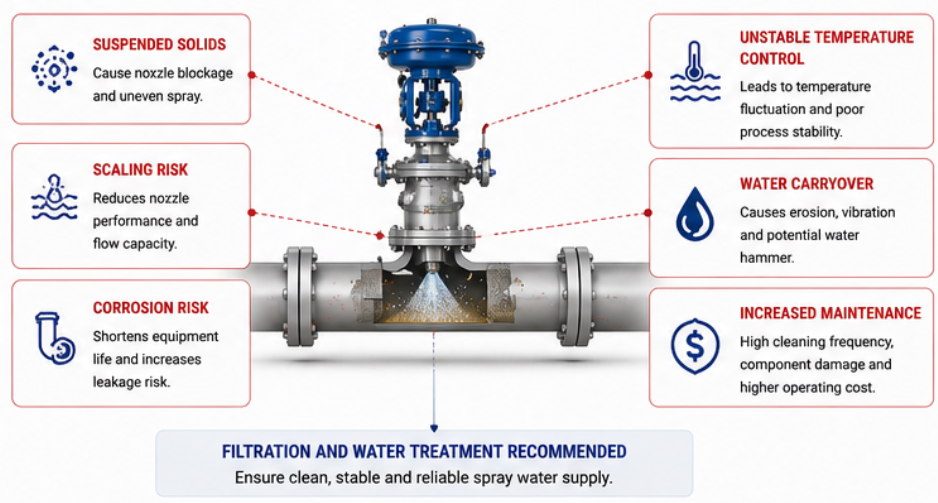
| Water Quality Issue | Possible Impact |
|---|---|
| Suspended Solids | May block nozzle passages and reduce spray performance. |
| High Hardness | May cause scaling and reduce atomization efficiency. |
| Corrosive Elements | May shorten nozzle, valve, and pipeline service life. |
| Unstable Water Supply | May cause temperature fluctuation and poor control performance. |
5. Match Spray Water Conditions With Piping Layout And Control Logic
Even if the spray water conditions are correct, the system still needs proper piping layout and control logic. After water is injected, droplets need enough downstream distance to evaporate and mix with steam. If the temperature sensor is too close to the injection point, it may measure an unstable mixture and cause poor control response.
Drainage is also important. If unevaporated water or condensate remains in the pipeline, it can cause erosion, vibration, and water hammer. The system should include proper drain points, pipe support, and maintenance access.
A professional supplier should review spray water data, steam data, nozzle design, spray water control valve, temperature sensor location, downstream straight pipe, drainage, and system testing together as one complete engineering solution.
Final Procurement Checklist
Confirm inlet steam pressure and temperature.
Confirm required outlet steam temperature.
Provide minimum, normal, and maximum steam flow.
Confirm spray water pressure and available flow.
Confirm spray water temperature and water quality.
Review nozzle atomization performance.
Check spray water control valve selection.
Confirm downstream straight pipe length.
Check temperature sensor location.
Review drainage, filtration, testing, and maintenance access.
Conclusion
Spray water conditions play a major role in steam desuperheating performance. Water pressure affects atomization, water flow affects cooling capacity, water temperature affects heat absorption, and water quality affects nozzle reliability and long-term maintenance.
For industrial steam systems, buyers should provide complete spray water data before ordering a desuperheater. A well-designed system combines proper nozzle selection, stable spray water control, accurate temperature feedback, suitable piping layout, and reliable drainage to achieve stable outlet steam temperature and safe operation.
FAQ
Why is spray water pressure important in steam desuperheating?
Spray water pressure affects atomization quality. Better atomization helps water droplets evaporate faster and improves outlet temperature stability.
What happens if spray water flow is too high?
Excessive spray water may cause wet steam, water carryover, pipe erosion, water hammer, and unstable temperature control.
Why does water quality matter?
Poor water quality may block nozzles, cause scaling, corrode components, and reduce long-term system reliability.
What information should buyers provide before quotation?
Buyers should provide spray water pressure, temperature, quality, available flow, steam pressure, steam temperature, steam flow range, and outlet temperature target.
Need Help Reviewing Spray Water Conditions?
Send us your steam pressure, steam temperature, steam flow range, outlet temperature target, spray water pressure, water temperature, and water quality. Our engineering team can help you review the working conditions and provide a suitable steam desuperheating solution.
Get Quote Contact Us