

What Buyers Should Check Before Ordering A Steam Desuperheater
2026-05-13 22:151. Confirm Steam Conditions Before Selection
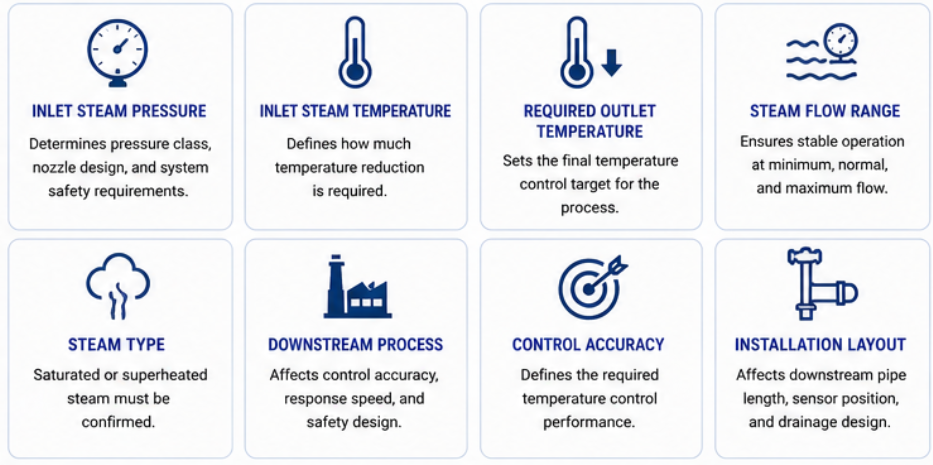
The first step before ordering a steam desuperheater is to confirm the actual steam conditions. A desuperheater cannot be selected correctly by pipe size alone. Buyers should provide inlet steam pressure, inlet steam temperature, required outlet temperature, steam flow range, steam type, and downstream process requirements.
Steam flow range is especially important. A desuperheater must work not only at normal flow, but also at minimum and maximum flow. If the equipment is not suitable for low-flow operation, spray water may not fully evaporate. If the equipment is not suitable for peak flow, the outlet temperature may remain too high.
Buyers should also clarify whether the steam temperature needs to be reduced close to saturation temperature or only lowered to a safer process range. This affects desuperheater type, spray water quantity, nozzle design, and control strategy.
Key Steam Data Buyers Should Provide
| Required Data | Why It Matters |
|---|---|
| Inlet Steam Pressure | Determines pressure class, nozzle design, and system safety requirements. |
| Inlet Steam Temperature | Defines how much temperature reduction is required. |
| Required Outlet Temperature | Sets the final temperature control target for the process. |
| Steam Flow Range | Ensures stable operation at minimum, normal, and maximum flow. |
| Downstream Process | Affects temperature accuracy, response speed, and safety design. |
2. Check Spray Water Conditions And Atomization Quality
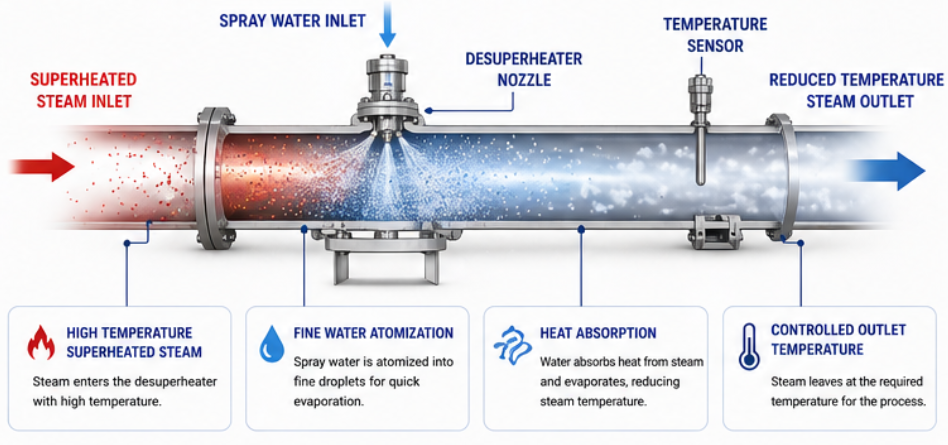
Spray water condition is one of the most important factors in desuperheater performance. The spray water must be injected in the right amount and atomized into fine droplets so it can evaporate quickly in the steam flow. Poor atomization can cause wet steam, temperature instability, pipe erosion, water hammer, and thermal stress.
Buyers should provide spray water pressure, spray water temperature, water quality, available water flow, and control method. If the spray water pressure is too low, the nozzle may not atomize properly. If the water quality is poor, the nozzle may become blocked or scaled during operation.
The desuperheater supplier should review whether the spray water pressure is high enough compared with steam pressure and whether the nozzle design can achieve stable atomization across the operating range.
Spray Water Data To Confirm
| Spray Water Data | Procurement Impact |
|---|---|
| Water Pressure | Affects atomization quality and nozzle selection. |
| Water Temperature | Affects evaporation performance and water quantity calculation. |
| Water Quality | Helps prevent nozzle blockage, scaling, and contamination. |
| Available Water Flow | Confirms whether the system can meet the required outlet temperature. |
3. Review Desuperheater Type And Control Method
Different steam applications may require different desuperheater designs. Some systems use a simple spray nozzle, while others require variable-area nozzles, steam-atomizing designs, integrated control valves, or complete desuperheating skid packages. The right choice depends on steam flow range, temperature reduction target, spray water pressure, and required control accuracy.
For stable temperature control, the desuperheater should work together with a spray water control valve, temperature sensor, pressure transmitter, actuator, and control system. The temperature sensor location is also important because it affects response speed and measurement accuracy.
Buyers should ask whether the supplier can provide a complete control strategy instead of only a mechanical nozzle. For industrial process lines, the control method often determines whether the outlet steam temperature remains stable under changing load conditions.
Common Control Components
Desuperheater body or spray nozzle assembly
Spray water control valve
Temperature sensor or transmitter
Pressure transmitter
Control cabinet or PLC interface
Actuator and positioner
Drain and vent arrangement
Alarm or interlock function when required
Practical Tip
A steam desuperheater should not be evaluated only by the nozzle size. Buyers should review the full temperature control loop, including spray water control valve, temperature feedback, control accuracy, and downstream pipe length.
4. Check Downstream Pipe Length, Drainage, And Installation Layout
After spray water is injected into the steam flow, it needs enough distance to fully evaporate and mix with the steam. If the downstream straight pipe length is too short, the temperature sensor may read unstable values, water droplets may reach downstream equipment, and the control system may react incorrectly.
The piping layout should also include proper drainage. If unevaporated water or condensate accumulates in the pipeline, it may cause water hammer, erosion, vibration, and equipment damage. Drain points, slope direction, pipe supports, and maintenance access should be considered during the engineering stage.
For skid-mounted steam pressure reducing and desuperheating systems, buyers should confirm the skid layout, inlet and outlet direction, spray water connection, control cabinet location, lifting points, transportation size, and installation space before fabrication.
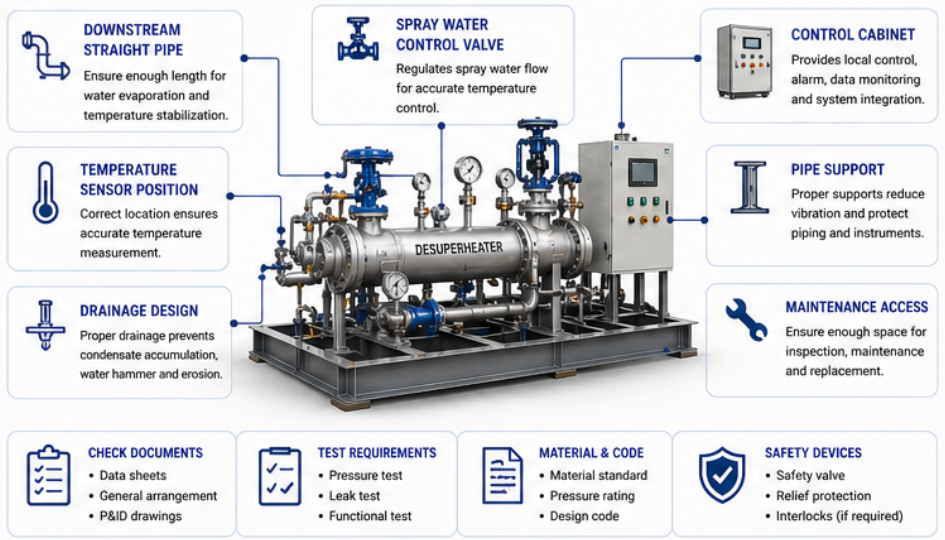
| Installation Factor | Why It Matters |
|---|---|
| Downstream Straight Pipe | Allows water droplets to evaporate and steam temperature to stabilize. |
| Temperature Sensor Position | Affects temperature feedback accuracy and control response. |
| Drainage Design | Prevents condensate accumulation, erosion, and water hammer. |
| Pipe Support | Reduces vibration and protects instruments and valves. |
5. Confirm Testing, Documents, And Supplier Engineering Support
Before ordering a steam desuperheater, buyers should confirm what testing and documentation will be provided. For a complete skid-mounted system, testing may include pressure test, leak test, functional inspection, instrument check, control cabinet inspection, and final visual inspection.
Useful documents include general arrangement drawing, P&ID, desuperheater data sheet, spray water control valve data sheet, instrument list, test reports, operation manual, and recommended spare parts list. These documents help with installation, commissioning, maintenance, and future spare parts management.
Buyers should also evaluate whether the supplier can support engineering review, not only product supply. A reliable supplier should be able to review steam data, calculate spray water demand, recommend desuperheater type, confirm layout requirements, and provide a clear technical proposal.
Final Buyer Checklist Before Ordering
Confirm inlet steam pressure and temperature.
Confirm required outlet steam temperature.
Provide minimum, normal, and maximum steam flow.
Confirm spray water pressure, temperature, quality, and available flow.
Review desuperheater type and nozzle design.
Check spray water control valve and temperature feedback method.
Confirm downstream straight pipe length and sensor location.
Check drainage, venting, pipe support, and maintenance access.
Request drawings, data sheets, test reports, and operation manual.
Conclusion
Ordering a steam desuperheater requires careful review of steam conditions, spray water conditions, atomization quality, control method, piping layout, drainage, testing, and documentation. A desuperheater that is selected only by pipe size or price may fail to provide stable temperature control in real operation.
For industrial buyers, the safest approach is to provide complete process data and work with a supplier that can review the full steam pressure reducing and desuperheating system. Correct selection helps improve temperature stability, protect downstream equipment, reduce water carryover, and improve long-term system reliability.
FAQ
What information is needed before ordering a steam desuperheater?
Buyers should provide steam pressure, steam temperature, flow range, required outlet temperature, spray water pressure, water quality, and installation layout information.
Why is spray water pressure important?
Spray water pressure affects atomization quality. Poor atomization may cause wet steam, unstable temperature, erosion, or water hammer.
Can a desuperheater be selected by pipe size only?
No. Pipe size is not enough. The selection should be based on steam conditions, spray water conditions, flow range, temperature target, and control accuracy.
Why is downstream straight pipe length important?
Enough downstream pipe length helps spray water evaporate fully and allows the temperature sensor to measure stable steam temperature.
Need Help Selecting A Steam Desuperheater?
Send us your steam pressure, temperature, flow range, outlet temperature target, spray water conditions, and project requirements. Our engineering team can help you review the working conditions and provide a suitable steam desuperheating solution.
Get Quote Contact Us