


Steam Pressure Reducing Skid vs Traditional Piping Assembly: Which Is Better
2026-05-12 22:121. What Is A Steam Pressure Reducing Skid?
A steam pressure reducing skid is a pre-engineered and skid-mounted system that integrates the main components required for pressure reduction and steam control. It may include a pressure reducing valve, control valve, desuperheater, spray water control valve, safety valve, pressure gauges, pressure transmitters, temperature sensors, drain valves, vent valves, control cabinet, piping, supports, and steel skid frame.
The main advantage of a skid-mounted system is that most engineering, fabrication, assembly, inspection, and testing can be completed in the factory before delivery. This reduces site work and helps ensure that the system is delivered as a complete package.
For overseas industrial projects, skid-mounted delivery is especially useful because it allows the buyer to review drawings, confirm component layout, inspect test results, and receive a more controlled system before the equipment reaches the site.
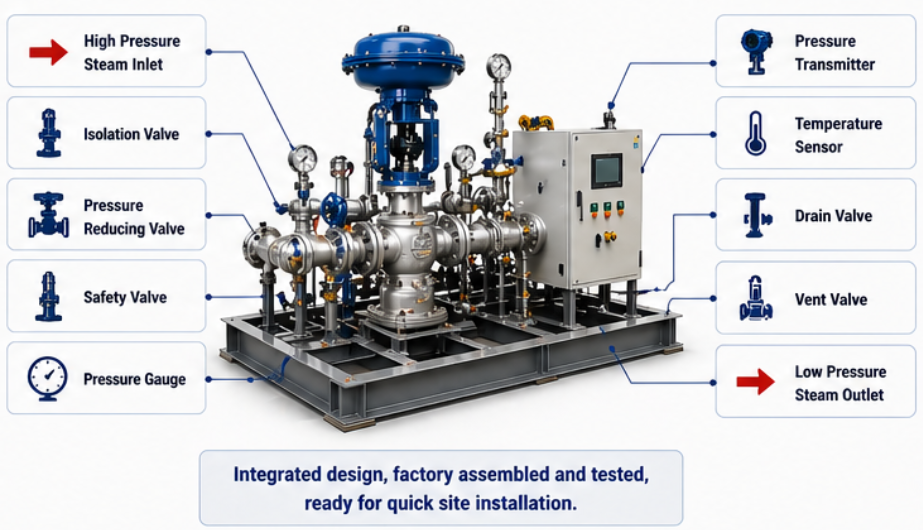
Typical Components In A Steam Pressure Reducing Skid
| Component | Function |
|---|---|
| Pressure Reducing Valve | Reduces high-pressure steam to the required process pressure. |
| Safety Valve | Protects downstream equipment from overpressure. |
| Pressure Transmitter | Provides feedback for pressure control and monitoring. |
| Control Cabinet | Supports local control, signal interface, alarms, and automation. |
| Skid Frame | Provides integrated support, lifting structure, and modular installation. |
2. What Is Traditional Piping Assembly?
Traditional piping assembly means that the steam pressure reducing system is built on site by installing separate valves, instruments, pipes, supports, drains, vents, and control components one by one. This approach may be suitable for projects with simple layouts, flexible field conditions, or when local installation teams have strong steam system experience.
The advantage of traditional assembly is site flexibility. Contractors can adjust piping direction and component position according to actual site conditions. However, this flexibility also introduces more uncertainty. Quality depends heavily on local installation skill, site management, welding quality, material preparation, and commissioning coordination.
If the project schedule is tight or the site team lacks experience with steam pressure control systems, traditional assembly may increase the risk of installation errors, missing components, poor instrument location, insufficient maintenance space, or unstable operation after startup.
Traditional Assembly Is Usually More Suitable When:
The project site has enough experienced installation resources.
The steam system is simple and does not require complex control logic.
The final layout cannot be confirmed before equipment delivery.
The project requires high field flexibility.
Factory skid transportation size is limited by site access or shipping conditions.
3. Skid-Mounted System vs Traditional Assembly: Key Comparison
The better option depends on project requirements. Buyers should compare both solutions based on installation time, quality control, testing, site labor, layout flexibility, maintenance access, and overall risk. A skid-mounted system usually performs better in project control and factory quality assurance, while traditional assembly may offer more site flexibility.
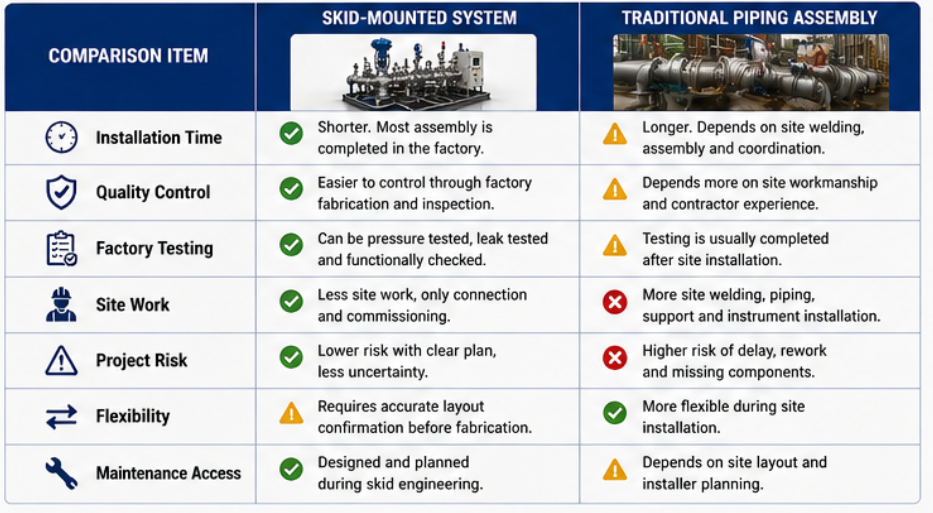
| Comparison Item | Steam Pressure Reducing Skid | Traditional Piping Assembly |
|---|---|---|
| Installation Time | Shorter, because most assembly is completed in the factory. | Longer, depends on site welding, assembly, and coordination. |
| Quality Control | Easier to control through factory fabrication and inspection. | Depends more on site workmanship and contractor experience. |
| Factory Testing | Can be pressure tested, leak tested, and functionally checked before shipment. | Testing is usually completed after site installation. |
| Project Risk | Lower when layout, interfaces, and scope are confirmed early. | Higher risk of missing parts, site modification, and installation delay. |
| Flexibility | Requires accurate layout confirmation before fabrication. | More flexible during field installation. |
| Maintenance Access | Can be planned during skid design. | Depends on site layout and installer planning. |
4. When Is A Steam Pressure Reducing Skid The Better Choice?
A skid-mounted steam pressure reducing system is usually the better choice when the project requires higher quality control, shorter site installation time, factory testing, and clearer scope management. It is also useful for overseas projects where the buyer wants to reduce site labor and avoid too many field modifications.
If the system includes multiple instruments, control cabinet, desuperheating section, safety valve, spray water control, drain and vent arrangement, or complex automation, skid-mounted integration can reduce coordination risk. The complete system can be designed as one package instead of being assembled from separate components at site.
A skid-mounted system also helps buyers review the equipment before delivery. Drawings, photos, inspection records, pressure test reports, and functional test results can be checked before shipment, reducing uncertainty during installation and commissioning.
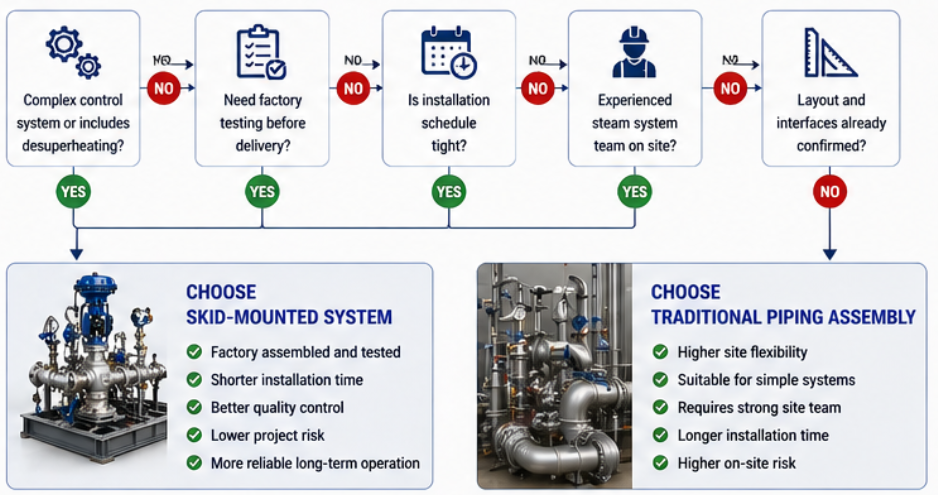
Skid-Mounted Design Is Recommended For:
Projects with tight installation schedules
Overseas projects requiring controlled factory inspection
Steam systems with pressure control and desuperheating
Projects requiring control cabinet and instrumentation integration
Industrial plants that want to reduce site welding and installation risk
Applications requiring stable pressure and reliable long-term operation
5. What Buyers Should Confirm Before Choosing
Before deciding between a steam pressure reducing skid and traditional piping assembly, buyers should confirm the technical scope, site conditions, delivery schedule, installation capability, testing requirements, and documentation needs. The best solution is not always the lowest-cost option at the quotation stage. It should reduce total project risk and support stable long-term operation.
If the site has strong installation capability and the system is simple, traditional assembly may be acceptable. If the project needs better quality consistency, lower site workload, and complete factory testing, a skid-mounted system is usually more suitable.
Buyer Decision Checklist
Is the steam pressure reducing system simple or complex?
Does the system include desuperheating or spray water control?
Is factory testing required before shipment?
Does the site have experienced steam piping installation resources?
Is the installation schedule tight?
Are inlet and outlet directions already confirmed?
Is maintenance access important for future operation?
Are drawings, test reports, and final documentation required?
Will site welding and installation quality be difficult to control?
Conclusion
A steam pressure reducing skid and traditional piping assembly can both be used for industrial steam pressure control. However, a skid-mounted system usually offers stronger advantages in factory quality control, shorter installation time, easier inspection, clearer scope management, and lower site risk.
Traditional piping assembly may still be suitable when the system is simple, site installation resources are strong, or layout flexibility is more important. For projects that require stable pressure control, desuperheating, instrumentation, factory testing, and reduced installation risk, a skid-mounted steam pressure reducing system is often the better choice.
FAQ
Is a skid-mounted steam pressure reducing system always better?
Not always. It is better for projects that need factory testing, shorter site installation, integrated instruments, and lower installation risk. Traditional assembly may be acceptable for simple systems with strong site installation capability.
Why does skid-mounted design reduce project risk?
Because most assembly, inspection, and testing can be completed in the factory before delivery, reducing site welding, missing parts, and installation errors.
When is traditional piping assembly suitable?
It may be suitable when the system is simple, site layout is uncertain, or the contractor has strong experience with steam piping and control systems.
What should buyers confirm before ordering a skid-mounted system?
Buyers should confirm steam parameters, system scope, skid layout, inlet and outlet direction, transportation size, testing requirements, and documentation package.
Need A Skid-Mounted Steam Pressure Reducing Solution?
Send us your steam pressure, temperature, flow range, site layout, and project requirements. Our engineering team can help you compare skid-mounted and site-assembled solutions and provide a suitable steam pressure reducing system.
Get Quote Contact Us