



How To Choose A Pressure Reducing Valve For Industrial Steam Systems
2026-05-11 22:031. Start With The Real Steam Working Conditions
The first step in choosing a pressure reducing valve for an industrial steam system is to confirm the actual working conditions. A valve should not be selected only by nominal pipe size. Steam pressure, temperature, flow rate, pressure drop, and downstream process requirements all affect valve performance.
Buyers should provide inlet pressure, inlet temperature, required outlet pressure, maximum flow, normal flow, minimum flow, steam type, and application details. If the steam demand changes frequently, the valve must be able to control pressure accurately across a wide operating range.
Incomplete working condition data can lead to oversized valves, undersized valves, unstable pressure control, excessive noise, vibration, erosion, and shorter service life. A reliable manufacturer should ask for complete steam data before recommending a valve model.
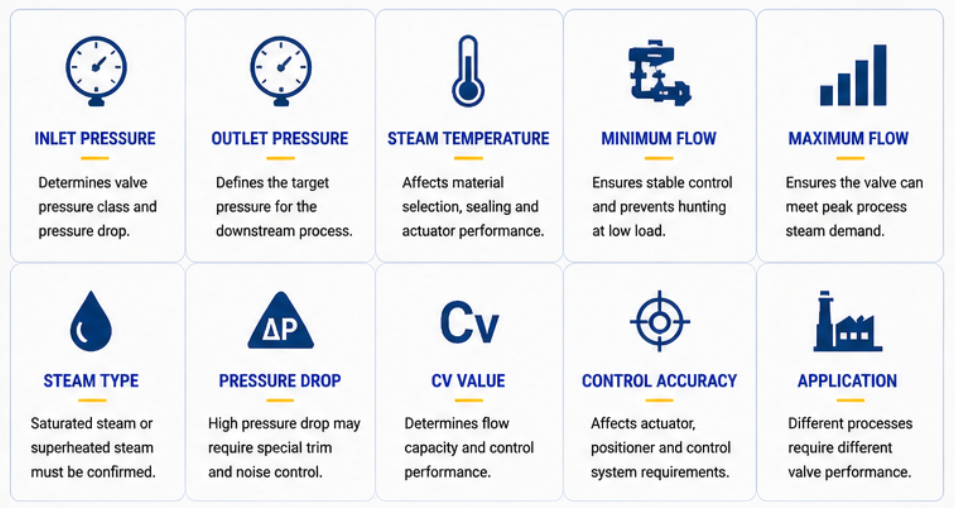
Key Data Required For Valve Selection
| Selection Data | Why It Matters |
|---|---|
| Inlet Pressure | Determines valve pressure class, pressure drop, and trim design. |
| Outlet Pressure | Defines the target pressure for downstream process equipment. |
| Steam Temperature | Affects valve material, sealing, actuator selection, and thermal design. |
| Flow Range | Helps confirm valve size, Cv value, and stable operation at low and peak load. |
| Application Type | Determines control accuracy, safety protection, and automation requirements. |
2. Avoid Selecting The Valve Only By Pipe Size
A common procurement mistake is choosing a steam pressure reducing valve based only on the pipeline diameter. In real steam systems, two valves with the same connection size may have very different flow capacity, trim structure, pressure drop capability, control range, and noise performance.
If the valve is oversized, it may operate at a very small opening. This can cause unstable pressure control, valve hunting, poor low-flow performance, and reduced control accuracy. If the valve is undersized, it may fail to supply enough steam during peak demand and cause downstream pressure drop.
Correct valve sizing should be based on calculated flow capacity, pressure drop, Cv value, turndown ratio, and actual operating range. For critical steam systems, the supplier should provide a clear sizing basis rather than only a model number.
Oversized vs Undersized Valve Risks
| Valve Selection Issue | Possible Result |
|---|---|
| Oversized Valve | Poor low-flow control, pressure fluctuation, and unstable valve movement. |
| Undersized Valve | Insufficient steam supply during peak load and downstream pressure loss. |
| Wrong Cv Selection | Inaccurate flow control and poor pressure stability. |
| Poor Turndown Range | The valve cannot perform well across minimum and maximum flow conditions. |
3. Check Valve Trim, Noise Control, And Severe Service Conditions
Steam pressure reduction often involves high pressure drop and high velocity. If the valve trim is not suitable, the valve may generate excessive noise, vibration, erosion, and unstable operation. These problems can damage the valve, piping, instruments, and downstream equipment.
For moderate pressure reduction, a standard valve trim may be acceptable. For high-pressure steam systems, multi-stage trim, low-noise trim, cage-guided structure, anti-erosion material, or special severe-service valve design may be required. The correct solution depends on pressure drop, flow rate, steam temperature, allowable noise level, and system layout.
Buyers should ask the supplier whether noise and vibration have been considered in the valve selection. If the pressure drop is large, it is risky to choose a basic valve only because it is cheaper.
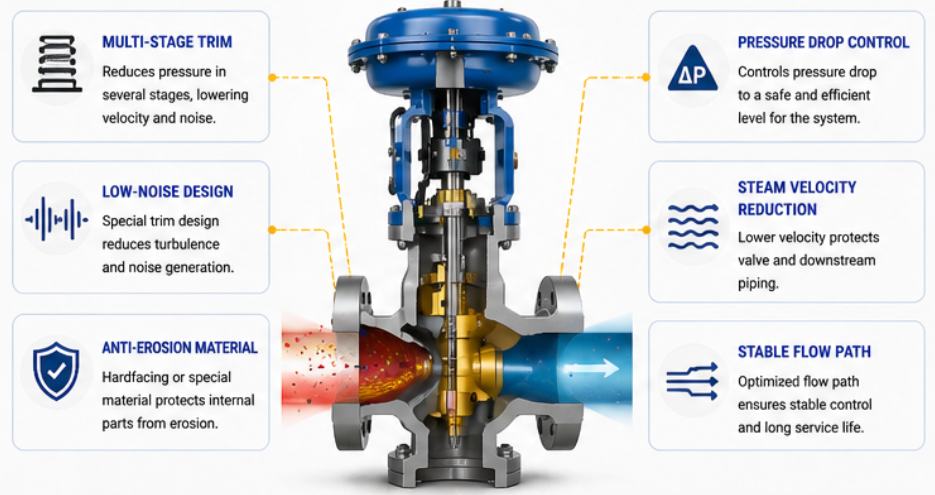
Valve Trim Selection Factors
Pressure drop across the valve
Steam velocity and flow rate
Noise and vibration limits
Risk of erosion under high-speed steam flow
Minimum and maximum flow control range
Valve opening range during normal operation
Material compatibility with steam temperature
Maintenance and spare part availability
4. Match The Actuator, Positioner, And Control Signal
A pressure reducing valve does not work alone. Its control performance depends on the actuator, positioner, control signal, and feedback system. Even a correctly sized valve may perform poorly if the actuator is too weak, the positioner is inaccurate, or the control signal is not suitable for the plant system.
Industrial steam systems may use pneumatic actuators, electric actuators, or electro-pneumatic control. Buyers should confirm the available air supply, power supply, signal type, fail-safe position, manual override requirement, response speed, and integration with DCS or PLC systems.
The fail-safe position is especially important. Depending on process safety requirements, the valve may need to fail close, fail open, or stay in last position during power or air failure. This should be confirmed before ordering.
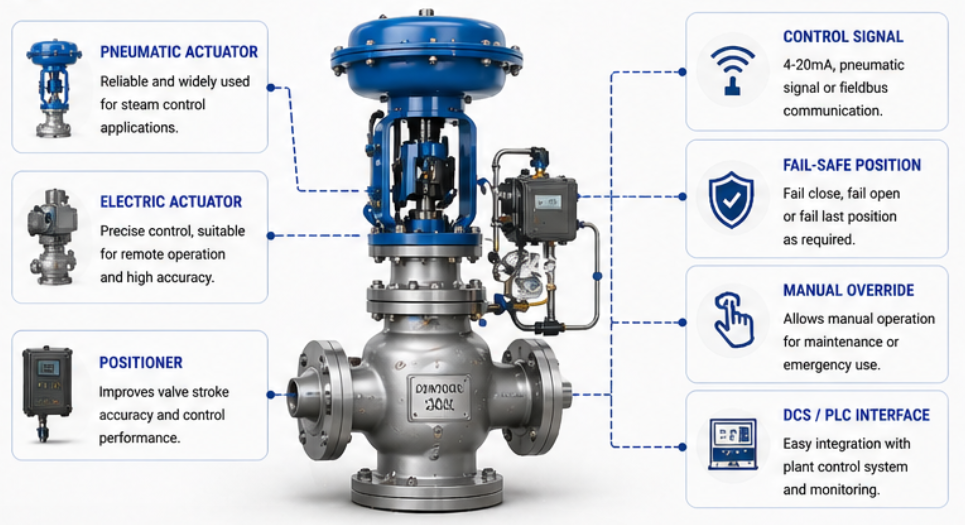
| Control Item | What To Confirm |
|---|---|
| Actuator Type | Pneumatic, electric, or electro-pneumatic actuator. |
| Positioner | Signal compatibility, response accuracy, and feedback function. |
| Control Signal | 4-20mA, pneumatic signal, digital communication, or plant system interface. |
| Fail-Safe Position | Fail close, fail open, or fail last according to process safety needs. |
| Manual Override | Useful for maintenance, commissioning, or emergency operation. |
5. Evaluate The Valve As Part Of The Complete Steam System
A pressure reducing valve should be selected as part of the complete steam pressure reducing system, not as an isolated component. The valve affects piping layout, safety valve sizing, pressure transmitter position, drain arrangement, pipe support, control cabinet design, and maintenance access.
If the system also includes desuperheating, the pressure reducing valve must be coordinated with the desuperheater, spray water control valve, temperature sensor, and downstream straight pipe length. Poor coordination can cause unstable pressure, poor temperature control, water droplets, or thermal stress.
A professional supplier should be able to provide a complete system proposal, including valve selection, P&ID, layout drawing, main component list, test requirements, and documentation package.
Practical Tip
For industrial steam systems, the best pressure reducing valve is not always the largest or cheapest one. It should be correctly sized, suitable for the pressure drop, stable at low and peak flow, matched with the right actuator, and integrated into the complete steam system design.
Buyer Selection Checklist
Confirm inlet pressure, outlet pressure, and steam temperature.
Provide minimum, normal, and maximum steam flow.
Ask for valve sizing basis and calculated Cv value.
Check whether the valve is oversized or undersized.
Review valve trim type and severe-service requirement.
Confirm actuator type, positioner, and control signal.
Check fail-safe position and manual override requirement.
Confirm noise, vibration, and erosion control measures.
Review safety valve and downstream protection design.
Ask for drawings, data sheets, test reports, and manuals.
Conclusion
Choosing a pressure reducing valve for industrial steam systems requires a full review of steam pressure, temperature, flow range, pressure drop, control accuracy, valve trim, actuator, positioner, safety requirements, and system layout. Selecting only by pipe size or lowest price can create serious operational problems.
A correctly selected valve helps maintain stable steam pressure, reduce noise and vibration, improve process reliability, protect downstream equipment, and lower long-term maintenance cost. For industrial projects, valve selection should always be part of a complete steam pressure reducing system design.
FAQ
Can a steam pressure reducing valve be selected by pipe size only?
No. Pipe size alone is not enough. The valve should be selected based on pressure, temperature, flow range, pressure drop, Cv value, and control requirements.
What happens if the valve is oversized?
An oversized valve may operate at a small opening, causing unstable pressure control, valve hunting, and poor low-flow performance.
When is low-noise trim needed?
Low-noise or multi-stage trim may be needed when the steam pressure drop is high, steam velocity is high, or the system has strict noise and vibration requirements.
Should the valve be selected together with the steam skid?
Yes. The valve affects piping layout, safety valve sizing, instrument position, control system, drainage, and maintenance access, so it should be selected as part of the full system.
Need Help Selecting A Steam Pressure Reducing Valve?
Send us your steam pressure, temperature, flow range, pressure reduction target, and process requirements. Our engineering team can help you review valve selection and provide a suitable steam pressure reducing system solution.
Get Quote Contact Us