


How To Choose A Steam Pressure Reducing And Desuperheating System
2026-05-06 12:571. Confirm The Steam Conditions Before Selection
The first step in choosing a steam pressure reducing and desuperheating system is to confirm the actual steam conditions. The system should be selected based on inlet steam pressure, inlet steam temperature, required outlet pressure, required outlet temperature, maximum flow rate, minimum flow rate, normal operating flow, and downstream process requirements.
Many procurement problems happen because the system is quoted with only rough pressure data. In real operation, steam flow may change frequently, and the downstream process may require stable pressure and temperature. If the pressure reducing valve or desuperheater is not sized correctly, the system may suffer from pressure fluctuation, poor temperature control, water carryover, noise, vibration, or unstable operation.
Buyers should also confirm whether the steam is saturated steam or superheated steam. This affects the desuperheating method, spray water demand, control accuracy, and system layout.
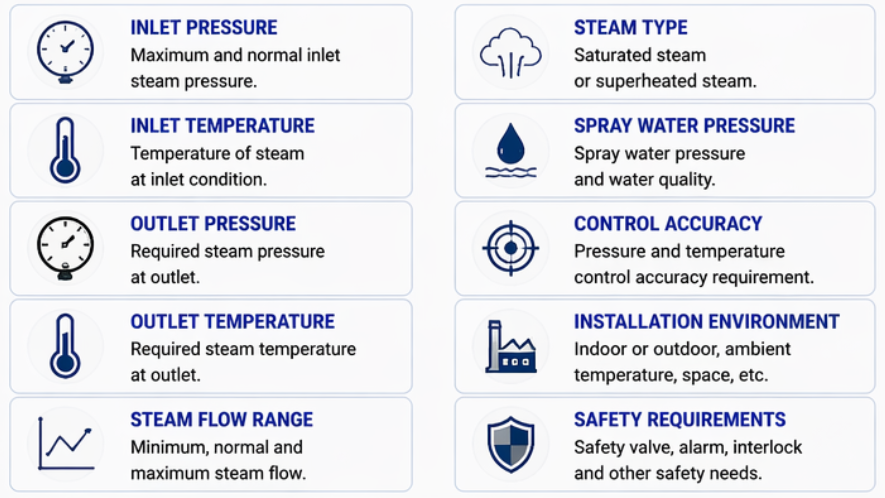
Key Steam Data To Prepare
| Steam Data | Why It Matters |
|---|---|
| Inlet Pressure | Determines valve pressure class, pressure drop, and system safety design. |
| Inlet Temperature | Affects material selection and desuperheating requirement. |
| Outlet Pressure | Defines process steam pressure and downstream equipment protection. |
| Outlet Temperature | Determines temperature control target and spray water capacity. |
| Steam Flow Range | Ensures stable control under minimum, normal, and peak load conditions. |
2. Evaluate The Pressure Reducing Valve And Desuperheater Design
The pressure reducing valve is the core component for reducing steam pressure, but it cannot be evaluated alone. In a complete steam pressure reducing and desuperheating system, the valve, desuperheater, spray water control valve, temperature sensor, pressure transmitter, safety valve, and control system must work together.
A high pressure drop may cause noise, vibration, erosion, and valve wear if the valve structure is not suitable. For demanding applications, multi-stage pressure reduction, low-noise trim, or special valve internals may be required. The manufacturer should review the steam pressure ratio, flow velocity, noise level, and pipeline arrangement before confirming the final design.
The desuperheater should also be selected according to steam flow range, required outlet temperature, spray water pressure, atomization quality, and downstream straight pipe length. Poor spray water atomization can lead to unstable temperature, water droplets, pipe erosion, or thermal shock.
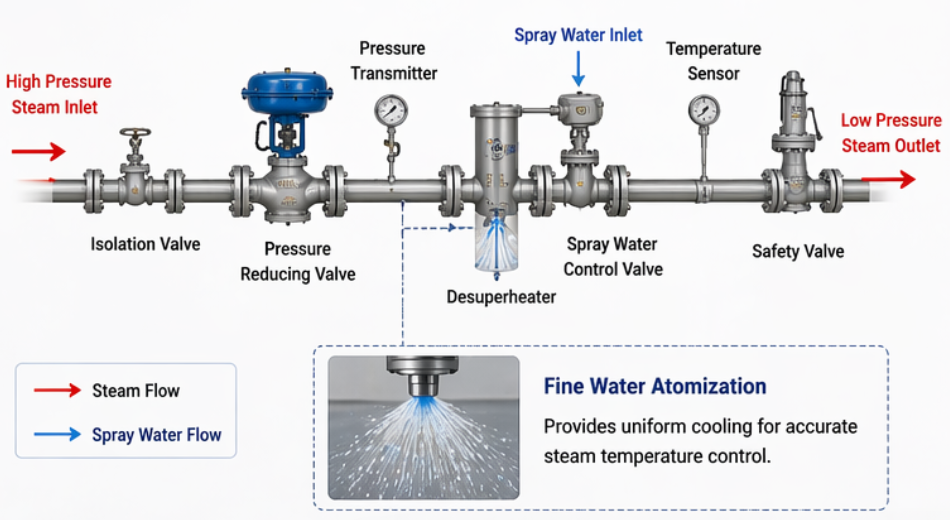
Main System Components
| Component | Function |
|---|---|
| Pressure Reducing Valve | Reduces high-pressure steam to the required process pressure. |
| Desuperheater | Lowers superheated steam temperature through controlled water injection. |
| Spray Water Control Valve | Controls water flow for accurate outlet steam temperature. |
| Temperature Sensor | Provides feedback for desuperheating control. |
| Pressure Transmitter | Monitors inlet and outlet steam pressure for stable operation. |
| Safety Valve | Protects downstream equipment from overpressure. |
3. Check Control Accuracy, Safety Protection, And Automation Requirements
A good steam pressure reducing and desuperheating system should maintain both pressure stability and temperature accuracy under changing load conditions. For simple applications, local pressure and temperature indication may be enough. For critical industrial processes, the system may require automatic control, remote monitoring, alarm signals, interlocks, and integration with a plant control system.
Safety protection should also be clearly reviewed. The system should include suitable safety valves, pressure gauges, transmitters, drain and vent points, and temperature monitoring. For high-temperature steam systems, the piping layout, expansion allowance, insulation, and maintenance access should also be considered.
Buyers should confirm whether the supplier can provide a control cabinet, actuator, positioner, signal interface, local display, and control logic description. This helps avoid problems during installation and commissioning.
Control And Safety Items To Confirm
Outlet pressure control accuracy
Outlet temperature control accuracy
Minimum and maximum steam flow control range
Spray water pressure and water quality requirement
Pressure and temperature transmitter configuration
Safety valve sizing and set pressure
Drain, vent, and maintenance access arrangement
Local control or remote control requirement
Alarm output and signal interface requirement
Noise, vibration, and thermal expansion considerations
Practical Tip
If the steam flow changes frequently or the downstream process is sensitive to temperature fluctuation, do not choose the system only by valve size. Ask the manufacturer to review pressure drop, control range, spray water atomization, and feedback control logic together.
4. Compare Skid-Mounted Design With Site-Assembled Design
Many industrial projects now prefer skid-mounted steam pressure reducing and desuperheating systems because they reduce site installation work and improve factory quality control. A skid-mounted system can integrate valves, desuperheater, instruments, piping, control cabinet, support frame, drains, vents, and wiring into a compact assembly.
Compared with site-assembled systems, a skid-mounted package can be pre-designed, pre-fabricated, pre-tested, and delivered as a modular unit. This reduces installation mistakes, shortens site construction time, and makes project coordination easier. However, buyers must confirm transportation size, lifting points, foundation requirements, inlet and outlet direction, and maintenance space.
For overseas projects, skid-mounted delivery also makes documentation and quality inspection more manageable. Buyers can request photos, test reports, and final inspection records before shipment.
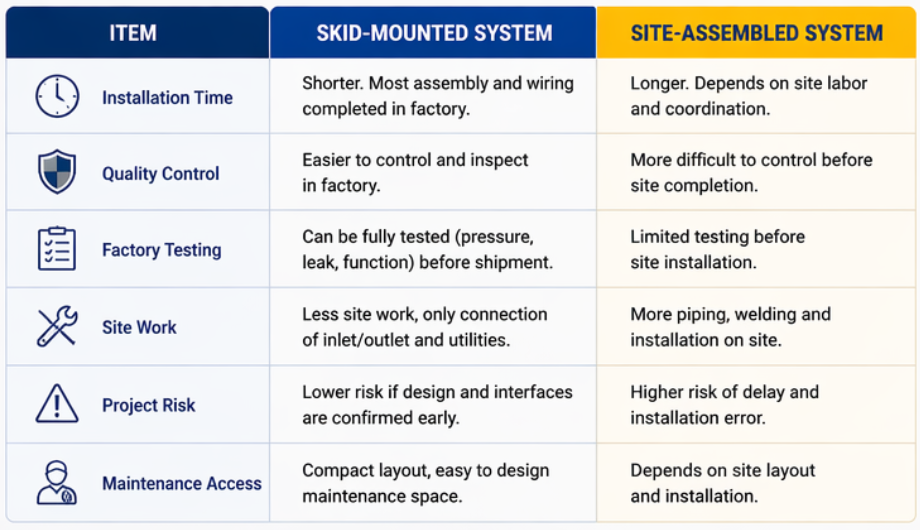
| Item | Skid-Mounted System | Site-Assembled System |
|---|---|---|
| Installation Time | Shorter, because most assembly is completed in factory. | Longer, depends more on site labor and coordination. |
| Quality Control | Easier to inspect and test before shipment. | More difficult to control before site completion. |
| Project Risk | Lower if layout and interfaces are confirmed early. | Higher risk of site modification and installation error. |
| Flexibility | Requires accurate layout confirmation before fabrication. | More flexible during field installation. |
5. Review Testing, Documentation, And Supplier Engineering Capability
Before purchasing a steam pressure reducing and desuperheating system, buyers should review the supplier’s engineering and manufacturing capability. The supplier should understand steam process requirements, valve sizing, desuperheating control, piping arrangement, instrumentation, welding, assembly, and factory testing.
Testing requirements may include pressure test, leak test, valve functional test, instrument check, control cabinet inspection, visual inspection, and final documentation review. For skid-mounted systems, factory inspection before shipment is an important way to reduce project risk.
A complete documentation package should include general arrangement drawing, P&ID, technical data sheets, component list, test reports, operation manual, packing information, and recommended spare parts list when required.
Recommended Procurement Checklist
Confirm steam inlet and outlet pressure.
Confirm inlet and outlet steam temperature.
Provide maximum, normal, and minimum steam flow.
Confirm whether steam is saturated or superheated.
Check pressure reducing valve sizing and pressure drop.
Confirm desuperheater type and spray water conditions.
Review temperature control accuracy and response requirements.
Confirm safety valve, drain, vent, and instrument arrangement.
Review skid layout, interface direction, and maintenance space.
Request drawings, test reports, and final inspection documents.
Conclusion
Choosing a steam pressure reducing and desuperheating system requires more than selecting a valve. Buyers need to evaluate the full steam condition, pressure reduction requirement, temperature control target, spray water system, safety protection, instrumentation, skid layout, testing requirements, and supplier engineering capability.
A well-designed system can provide stable outlet pressure, accurate steam temperature, safe operation, easier installation, and better long-term reliability. For industrial projects, clear technical data and early engineering review are the best ways to reduce procurement risk.
FAQ
What is a steam pressure reducing and desuperheating system?
It is a system used to reduce steam pressure and control steam temperature so the steam can meet downstream process requirements.
What information is needed before quotation?
Key information includes inlet pressure, inlet temperature, outlet pressure, outlet temperature, steam flow range, steam type, spray water conditions, and control requirements.
Why is desuperheating important?
Desuperheating reduces superheated steam temperature to the required process level and helps protect downstream equipment and process stability.
Is a skid-mounted system better than site assembly?
A skid-mounted system can reduce installation time and improve factory quality control, but the layout, interfaces, and transportation size must be confirmed before fabrication.
Need A Steam Pressure Reducing And Desuperheating Solution?
Send us your inlet pressure, outlet pressure, steam temperature, flow range, spray water conditions, and project requirements. Our engineering team can help you review the working conditions and provide a suitable skid-mounted steam pressure reducing and desuperheating system.
Get Quote Contact Us