

How To Reduce Procurement Risk When Buying A Custom Gas Skid System
2026-05-05 12:481. Define The Technical Requirements Before Asking For A Price
The biggest procurement risk usually starts before quotation. If the buyer only sends a simple request such as “we need a gas pressure regulating skid” or “please quote a gas skid system,” the supplier may make assumptions. These assumptions can lead to wrong regulator sizing, missing safety devices, incorrect material selection, unsuitable layout, or incomplete documentation.
A custom gas skid system should be quoted based on real working conditions. Buyers should provide gas medium, inlet pressure, outlet pressure, flow rate, temperature range, pipe size, connection standard, design pressure, installation environment, control requirements, and safety expectations. If the project has a P&ID, layout drawing, specification sheet, or previous system drawing, these documents should be shared at the inquiry stage.
Clear technical requirements help suppliers provide a more accurate proposal and also make it easier for buyers to compare quotations fairly. Without the same technical basis, a lower quotation may simply mean that some important items are missing.
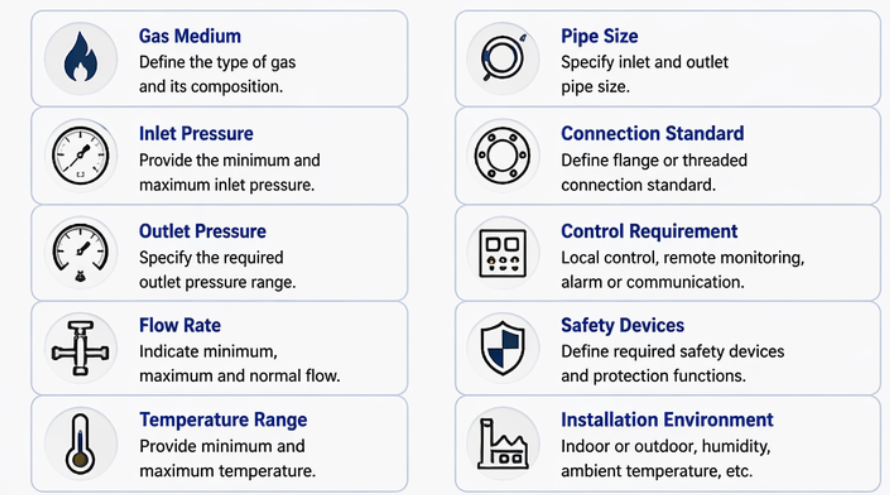
Key Information To Prepare Before Quotation
| Information | Why It Reduces Risk |
|---|---|
| Gas Medium | Helps confirm material, sealing, filtration, and safety requirements. |
| Inlet And Outlet Pressure | Determines regulator sizing, pressure class, and protection devices. |
| Flow Rate Range | Prevents undersized equipment and unstable pressure control. |
| Installation Environment | Affects coating, enclosure, instrument protection, and skid layout. |
| Control Requirement | Clarifies whether local control, remote monitoring, alarms, or signal output are needed. |
2. Confirm The Supplier Scope Clearly
Custom gas skid systems often involve many components. A quotation may include the skid frame and piping but exclude instruments, control cabinet, safety valves, spare parts, testing documents, or installation accessories. This is why buyers should not only compare the final price. They should compare the complete supply scope.
The supplier scope should clearly define what is included and what is excluded. For example, the proposal should state whether the skid includes filters, regulators, safety shut-off valves, relief valves, pressure gauges, transmitters, flow meters, control cabinet, wiring, terminal box, lifting points, skid base, painting, packaging, and test reports.
A complete scope list protects both the buyer and the manufacturer. It reduces commercial disputes, prevents missing items, and helps the project team understand what still needs to be prepared locally.
Scope Items Buyers Should Check
| Scope Category | Items To Confirm |
|---|---|
| Mechanical Components | Valves, regulators, filters, piping, flanges, fittings, skid frame. |
| Safety Devices | Safety shut-off valve, relief valve, monitor regulator, vent line, emergency shut-off. |
| Instrumentation | Pressure gauges, transmitters, temperature sensors, flow meters, alarms. |
| Control System | Control cabinet, signal output, wiring, terminal box, remote monitoring interface. |
| Documents | Drawings, data sheets, test reports, manuals, certificates when required. |
3. Review Engineering Drawings Before Production
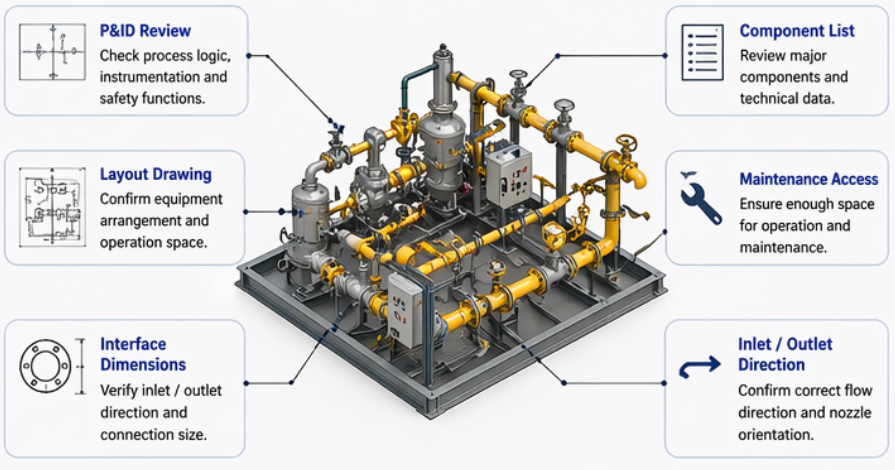
For a custom gas skid system, drawing review is one of the most effective ways to reduce procurement risk. Before production begins, the buyer should review the general arrangement drawing, piping and instrumentation diagram, foundation or skid layout, major component list, and interface dimensions.
Drawings help confirm whether the skid fits the site, whether operation and maintenance space is sufficient, whether inlet and outlet directions are correct, and whether key components are arranged logically. Drawing review can also reveal potential problems such as blocked maintenance access, incorrect nozzle orientation, insufficient drain or vent arrangement, or unsuitable instrument location.
Buyers should avoid approving production based only on a price list. For project equipment, a clear drawing approval process is an important part of procurement control.
Practical Tip
Before confirming an order, ask for a preliminary layout, process description, and main component list. Before fabrication, confirm the final drawings in writing. This simple step can prevent many expensive mistakes.
4. Check Testing, Inspection, And Quality Control Requirements
Custom gas skid procurement risk is not only about design. Manufacturing quality, assembly quality, pressure testing, leak testing, welding inspection, instrument checking, and factory acceptance also matter. A skid that looks complete may still create risk if it has not been properly tested before shipment.
Buyers should define testing requirements in the purchase order or technical agreement. Common requirements may include visual inspection, dimensional inspection, pressure test, leak test, functional test, instrument calibration check, electrical continuity check, painting inspection, and final packaging inspection.
For overseas projects, test reports and photos are especially useful. They help the buyer confirm manufacturing progress and reduce uncertainty before shipment.
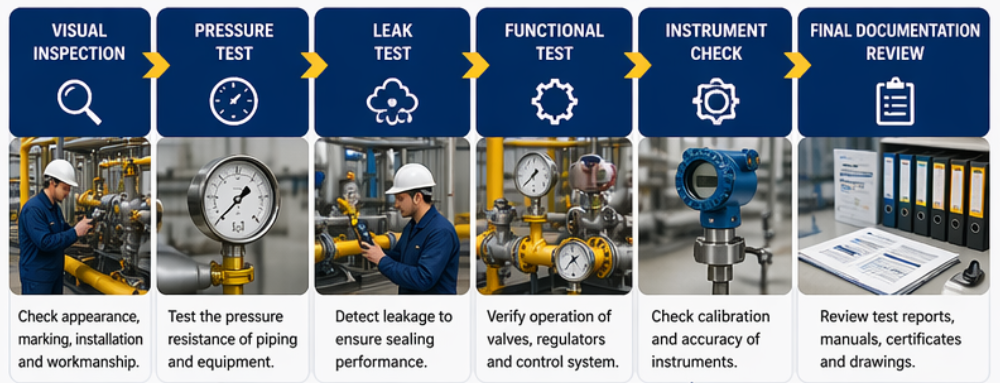
Recommended Inspection And Testing Items
| Inspection Item | Purpose |
|---|---|
| Visual Inspection | Checks appearance, assembly quality, markings, and component installation. |
| Pressure Test | Verifies pressure resistance of piping and pressure-bearing parts. |
| Leak Test | Confirms sealing performance of joints, valves, and connections. |
| Functional Test | Checks operation of regulators, valves, instruments, and control functions. |
| Final Documentation Review | Ensures drawings, reports, manuals, and certificates are complete before delivery. |
5. Avoid Choosing Only By The Lowest Price
Price is important, but the lowest price is not always the lowest risk. A custom gas skid system must match the working condition, safety requirements, and project documentation needs. A lower quotation may exclude safety devices, use simplified instruments, reduce testing scope, or provide limited engineering support.
Buyers should compare quotations based on technical scope, component quality, manufacturing capability, testing plan, document package, delivery schedule, and communication responsiveness. If two quotations are very different, the buyer should ask for a scope comparison rather than assuming they represent the same system.
A reliable gas skid supplier should be able to explain the design logic, show the main components, provide drawings, define testing requirements, and support technical communication before and after delivery.
Risk Reduction Checklist
Confirm complete working condition data before quotation.
Request a clear scope of supply and exclusion list.
Review P&ID, layout drawing, and component list before production.
Confirm safety devices and protection logic.
Define pressure test, leak test, and functional test requirements.
Ask for test reports, inspection records, and final photos before shipment.
Check packaging and lifting design for overseas transportation.
Compare suppliers by engineering capability, not price alone.
Conclusion
Reducing procurement risk when buying a custom gas skid system starts with clear technical requirements and continues through scope confirmation, drawing review, safety configuration, testing, documentation, and supplier evaluation. A gas skid is not just a collection of pipes and valves. It is an engineered system that must operate safely and reliably under real industrial conditions.
Buyers who prepare complete data, review drawings carefully, confirm testing requirements, and compare suppliers by engineering capability can significantly reduce project risk and avoid costly problems after delivery.
FAQ
What is the biggest procurement risk when buying a custom gas skid?
The biggest risk is usually unclear technical scope. If working conditions, safety devices, instruments, and testing requirements are not defined, quotations may be incomplete or difficult to compare.
Why should drawings be reviewed before production?
Drawing review helps confirm layout, interface dimensions, maintenance access, component arrangement, and process logic before manufacturing begins.
Is the lowest quotation always the best choice?
No. A lower quotation may exclude important components, safety devices, tests, or documents. Buyers should compare complete scope and engineering support.
What documents should be requested before shipment?
Common documents include final drawings, component list, pressure test report, leak test report, inspection records, operation manual, and packing details.
Need Support For A Custom Gas Skid System?
Send us your gas medium, pressure range, flow data, layout requirements, and project conditions. Our team can help you review the technical scope and provide a suitable custom gas skid system solution.
Get Quote Contact Us