


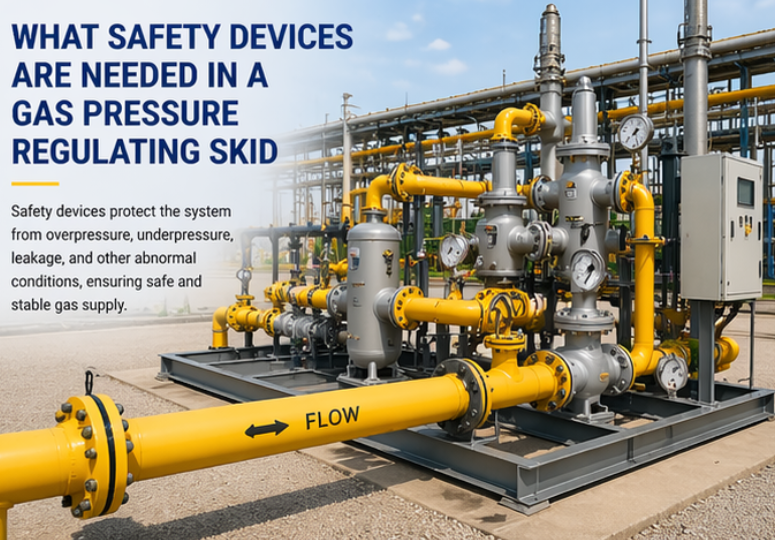
What Safety Devices Are Needed In A Gas Pressure Regulating Skid
2026-05-04 12:391. Why Safety Devices Matter In A Gas Pressure Regulating Skid
In an industrial gas system, a regulating skid is not only expected to control pressure during normal operation. It must also protect the downstream process when abnormal conditions occur. Overpressure, underpressure, gas leakage, regulator failure, contamination, and sudden flow changes can all affect system safety and process continuity.
For buyers and engineers, the right safety devices reduce the chance of downstream equipment damage, unplanned shutdown, and maintenance problems. A skid without proper protection may seem less expensive at the quotation stage, but it often carries much higher operating risk.
The most effective gas pressure regulating skids combine mechanical protection devices, monitoring instruments, and warning or shutdown functions. Together, these form a safer and more reliable gas control system.
2. Core Safety Devices That Are Usually Required
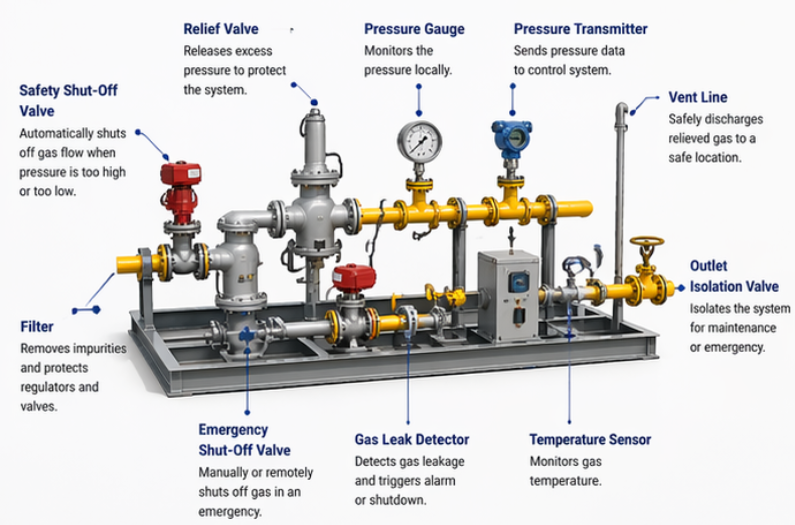
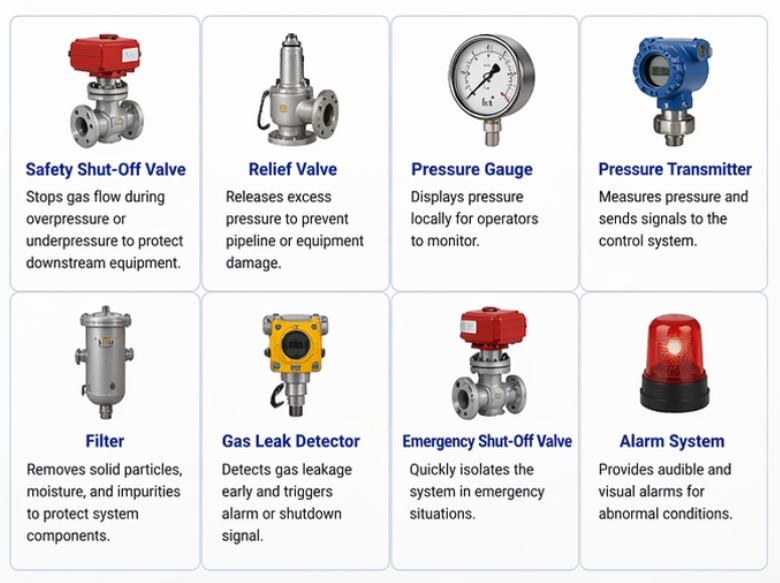
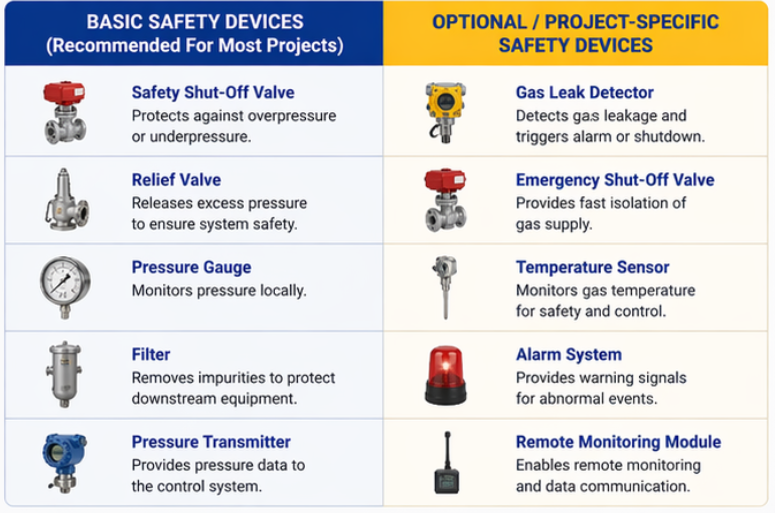
One of the most important safety devices is the safety shut-off valve. Its job is to automatically stop gas flow when outlet pressure rises too high or falls too low. This protects downstream burners, boilers, furnaces, and other equipment from abnormal pressure conditions.
Another key device is the relief valve, which releases excess pressure when the system exceeds its safe operating limit. In some projects, a monitor regulator may also be used as a backup protection method. Whether the project uses a relief valve, a monitor regulator, or both depends on the design philosophy and safety requirements.
Pressure gauges and pressure transmitters are also essential. Gauges provide local visual indication, while transmitters allow real-time monitoring through a control system. These devices help operators identify abnormal pressure before the problem becomes more serious.
A filter or filter separator should also be included in most cases. Although it is often considered a process component, it has a strong protective function because it prevents dust, rust particles, moisture, and other contaminants from damaging the regulator and valves.
| Safety Device | Main Function |
|---|---|
| Safety Shut-Off Valve | Stops gas flow during overpressure or underpressure conditions |
| Relief Valve | Releases excess pressure to protect downstream equipment |
| Monitor Regulator | Provides backup pressure control if the main regulator fails |
| Pressure Gauge | Shows local pressure condition for operators |
| Pressure Transmitter | Sends pressure data to the control system |
| Filter / Filter Separator | Protects regulators and valves from contamination |
3. Additional Safety Devices For More Demanding Projects
In more advanced or higher-risk installations, the skid may also require additional safety devices beyond the basic configuration. A gas leak detector is especially useful in enclosed or semi-enclosed environments. It can detect leakage from valves, flanges, and fittings and trigger an alarm before the gas accumulates to a dangerous level.
An emergency shut-off valve may also be included for rapid isolation. This valve can be activated manually, electrically, or by signal logic from a gas detector or alarm system. In some projects, this function is part of a wider emergency response design.
Temperature sensors, alarm systems, and remote monitoring modules may also be required depending on project standards, plant automation level, and the critical nature of the gas supply.
Buyers should not assume that every skid needs the same level of protection. Instead, the safety package should be matched to the project’s operating conditions, automation requirements, and acceptable risk level.
4. How Buyers Should Evaluate The Safety Configuration
When reviewing a quotation or technical proposal, buyers should ask whether the skid includes both protective devices and monitoring devices. It is also important to check if the protection logic matches the actual project. For example, a small general-purpose gas system may only require a basic shut-off valve, relief valve, gauge, and filter, while a critical process line may require leak detection, remote alarm, emergency shutdown, and signal interlocking.
Buyers should also review the safety device brands, pressure ranges, material compatibility, signal requirements, and maintenance accessibility. A technically correct device is only valuable if it is easy to inspect, maintain, and integrate into the plant system.
Practical Tip
A good gas pressure regulating skid should not only regulate pressure during normal operation. It should also protect the system when something goes wrong. This is why safety shut-off, overpressure protection, monitoring, and contamination control should all be reviewed together.
Conclusion
A gas pressure regulating skid should never be evaluated only by regulator size or flow capacity. The safety devices included in the skid are equally important because they determine how the system behaves when conditions become abnormal.
At a minimum, most industrial gas pressure regulating skids should include a safety shut-off valve, overpressure protection such as a relief valve or monitor regulator, pressure indication, and filtration. For higher-risk or more automated projects, leak detection, emergency shut-off, alarms, and remote monitoring may also be required.
FAQ
What is the most important safety device in a gas pressure regulating skid?
The safety shut-off valve is one of the most important because it automatically isolates gas flow when pressure moves beyond the preset safe range.
Is a relief valve always required?
Some form of overpressure protection is generally required. This may be a relief valve, a monitor regulator, or a combination depending on the project design.
Why is a filter important in the skid?
A filter protects regulators and valves from dust, rust particles, and moisture that may reduce control accuracy or cause failure.
Do all projects need gas leak detectors and emergency shut-off valves?
Not always. These devices are often added for enclosed spaces, high-risk installations, or projects with higher automation and safety requirements.
Need A Safe And Reliable Gas Pressure Regulating Skid For Your Project?
Send us your gas medium, pressure range, flow requirement, and project conditions. Our team can help you review the safety configuration and provide a suitable gas pressure regulating skid solution.
Get Quote Contact Us