



Single-Stage vs Two-Stage Gas Pressure Regulation: Which Design Is Better
2026-05-03 12:281. What Is Single-Stage Gas Pressure Regulation?
Single-stage gas pressure regulation means the gas pressure is reduced from the inlet pressure to the required outlet pressure through one pressure regulator. The system is usually composed of an inlet shut-off valve, filter or filter separator, pressure regulator, pressure gauge, outlet valve, and necessary safety accessories.
This design is widely used in general industrial gas supply, small boiler rooms, heating systems, production workshops, and applications where the inlet pressure is relatively stable. It is compact, easier to operate, and usually has a lower initial cost than a two-stage system.
However, single-stage regulation has limitations. If the inlet pressure is very high, the pressure ratio is too large, or the downstream process requires very stable outlet pressure, one regulator may not provide enough control accuracy. In such cases, the regulator may experience higher noise, vibration, wear, and unstable outlet pressure under changing flow conditions.
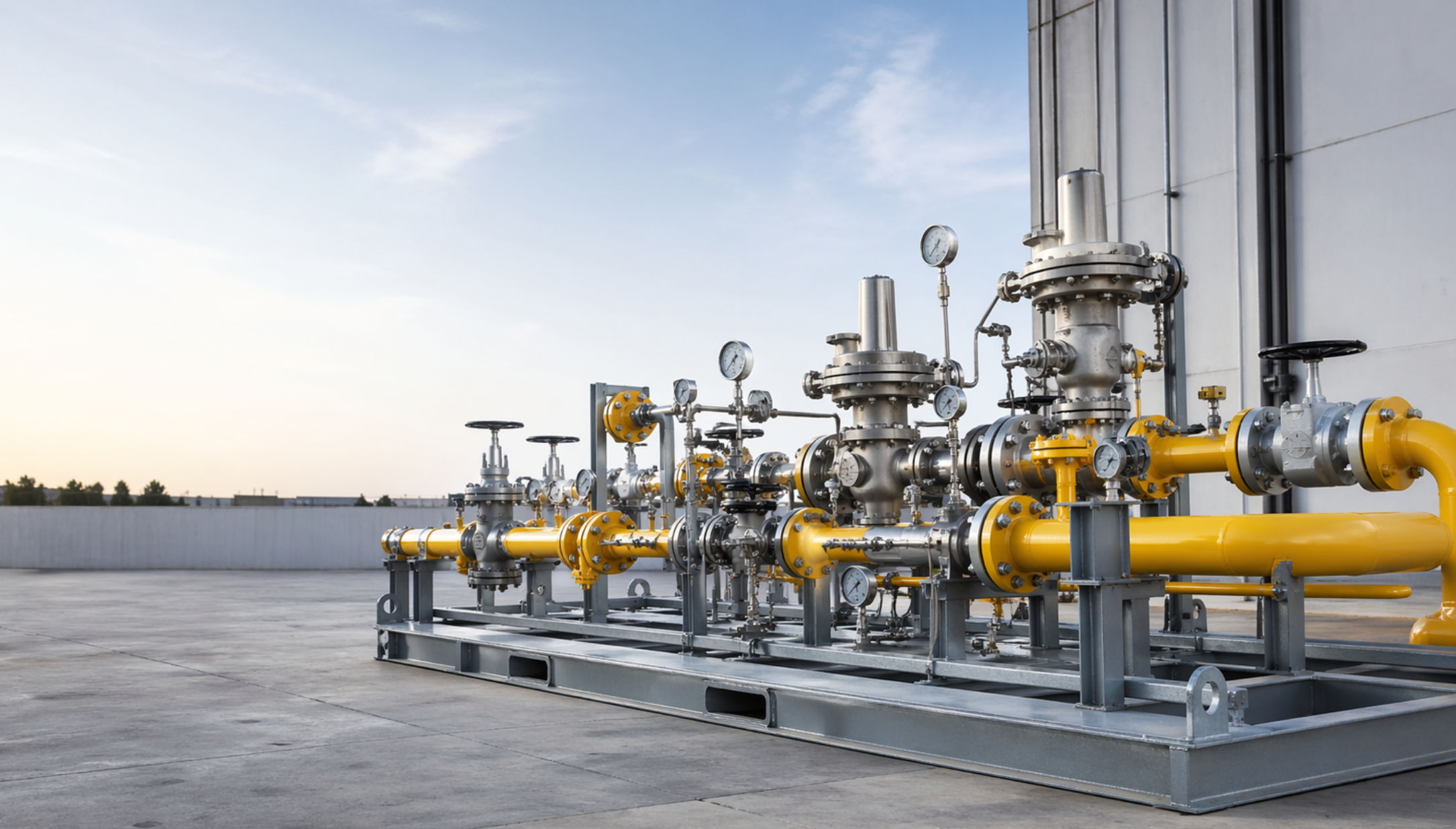
Single-Stage Regulation Is Usually Suitable For:
Moderate inlet pressure
Low to medium pressure ratio
Stable gas flow demand
General industrial gas supply
Projects with limited installation space
Applications where basic pressure control is enough
2. What Is Two-Stage Gas Pressure Regulation?
Two-stage gas pressure regulation uses two regulators in series. The first-stage regulator reduces high inlet pressure to an intermediate pressure. The second-stage regulator then reduces the intermediate pressure to the final required outlet pressure. This progressive pressure reduction makes the system more stable and more suitable for demanding industrial conditions.
Two-stage regulation is commonly used when the inlet pressure is high, the pressure ratio is large, the flow rate changes frequently, or the downstream equipment requires precise and stable pressure. It is also preferred for critical processes where unstable gas pressure may affect burners, furnaces, boilers, turbines, production lines, or safety systems.
Although a two-stage regulating skid has more components and a higher initial cost, it can provide better outlet pressure accuracy, lower noise, reduced regulator load, longer component life, and better long-term performance. For many industrial projects, this added stability can reduce operating risk and maintenance cost.
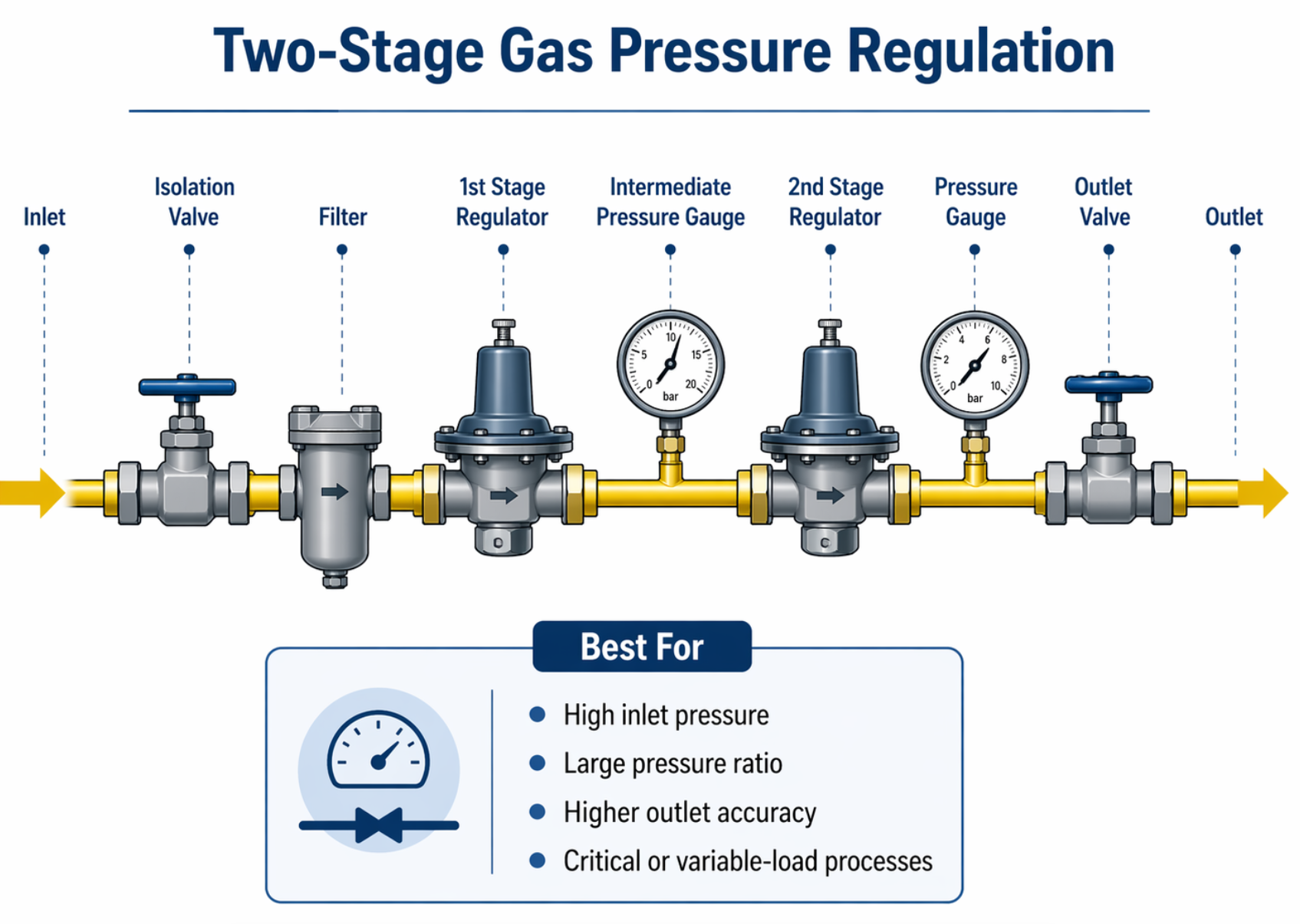
Two-Stage Regulation Is Usually Suitable For:
High inlet pressure
Large pressure reduction ratio
Strict outlet pressure accuracy
Large or unstable flow demand
Critical industrial processes
Applications requiring lower noise and smoother operation
3. Key Differences Between Single-Stage And Two-Stage Regulation
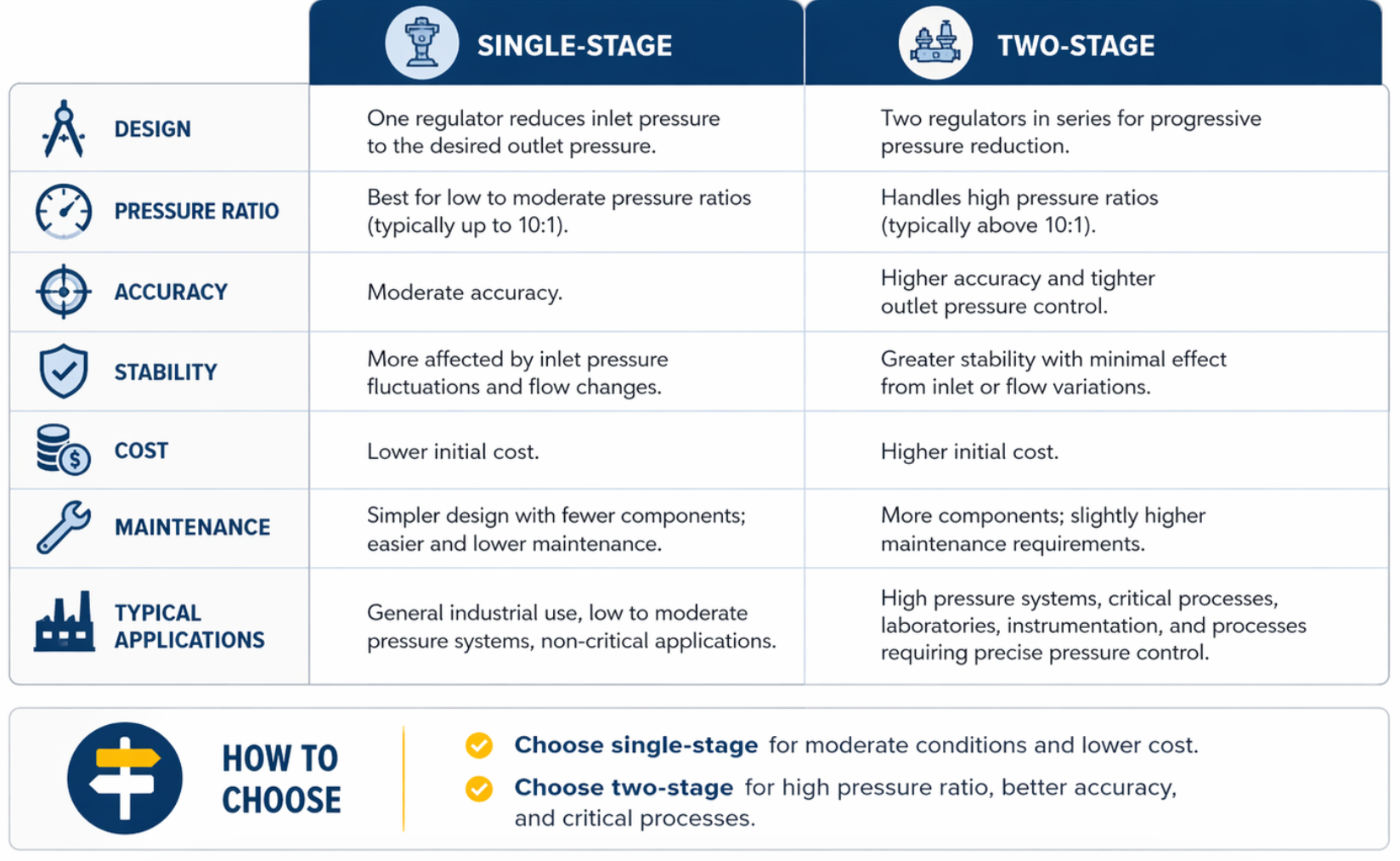
The main difference is not only the number of regulators. The real difference lies in how the system handles pressure drop, flow variation, regulator load, safety margin, and outlet pressure stability. For procurement decisions, buyers should compare both designs based on actual working conditions instead of choosing only by initial price.
| Comparison Item | Single-Stage Regulation | Two-Stage Regulation |
|---|---|---|
| Design Structure | One regulator reduces pressure in one step | Two regulators reduce pressure progressively |
| Pressure Ratio | Better for low to moderate pressure ratios | Better for large pressure ratios |
| Outlet Accuracy | Moderate pressure control accuracy | Higher and more stable outlet accuracy |
| Flow Stability | More affected by inlet pressure and flow changes | More stable under variable conditions |
| Noise And Vibration | May be higher under large pressure drop | Lower noise and smoother operation |
| Skid Size | More compact | Larger due to additional regulator and instruments |
| Initial Cost | Lower | Higher |
| Best Applications | General industrial gas use, stable low-pressure systems | High-pressure systems, critical processes, large pressure reduction |
4. How To Choose The Better Design For Your Project
There is no one-size-fits-all answer. The better design depends on pressure ratio, gas flow demand, downstream sensitivity, process importance, safety requirements, and budget. A single-stage design may be the best choice for simple systems, while a two-stage design is usually better for demanding or critical applications.
If the inlet pressure is only moderately higher than the outlet pressure, the gas flow is stable, and the downstream equipment does not require extremely tight pressure control, single-stage regulation can be economical and efficient. It reduces unnecessary system complexity and keeps installation space smaller.
If the inlet pressure is high, the outlet pressure must remain very stable, or the flow rate changes significantly during operation, two-stage regulation is usually the safer choice. By dividing the pressure drop into two steps, each regulator works under a more reasonable condition, which improves stability and reduces the risk of regulator overload.
Choose Single-Stage When:
The pressure reduction ratio is moderate
Outlet accuracy requirement is not extremely strict
Flow demand is relatively stable
Installation space is limited
Budget control is a major priority
Choose Two-Stage When:
The inlet pressure is high
The pressure ratio is large
Outlet pressure must be highly stable
The downstream process is sensitive
Flow demand changes frequently
5. Procurement Risks To Avoid
A common mistake is selecting the regulating design only by price. A lower-cost single-stage skid may appear attractive, but it can become more expensive if the system cannot maintain stable pressure, requires frequent adjustment, produces excessive noise, or causes downstream process instability.
Another common mistake is ignoring minimum flow and maximum flow conditions. A regulator that performs well at normal flow may not perform well at very low or peak flow. For industrial projects, the selection should consider the full operating range rather than only the nominal flow rate.
Buyers should also confirm whether the manufacturer can provide proper drawings, regulator sizing, component lists, pressure test reports, leak test reports, and operation manuals. For customized gas pressure regulating skids, engineering support is just as important as hardware supply.
Practical Selection Tip
If your pressure ratio is high, your outlet pressure accuracy is critical, or your process cannot tolerate pressure fluctuation, two-stage regulation is usually the safer and more reliable choice. If the working condition is moderate and stable, single-stage regulation may provide better cost efficiency.
Conclusion
Single-stage and two-stage gas pressure regulation each have clear advantages. Single-stage regulation is compact, economical, and suitable for stable applications with moderate pressure reduction. Two-stage regulation provides better pressure stability, higher outlet accuracy, smoother operation, and stronger reliability for high-pressure or critical industrial projects.
The best choice should be based on real working conditions, including inlet pressure, outlet pressure, flow range, pressure ratio, downstream process sensitivity, operating continuity, safety requirements, and maintenance expectations. A professional gas pressure regulating skid should be selected through engineering evaluation, not only by comparing equipment price.
FAQ
Is two-stage regulation always better than single-stage regulation?
Not always. Two-stage regulation offers better stability for demanding conditions, but single-stage regulation can be more cost-effective for moderate and stable applications.
When should I choose two-stage gas pressure regulation?
Two-stage regulation is recommended when the inlet pressure is high, the pressure ratio is large, the outlet pressure must be stable, or the downstream process is sensitive to pressure fluctuation.
Is single-stage regulation suitable for industrial projects?
Yes. Single-stage regulation is suitable for many industrial projects where inlet pressure is moderate, flow demand is stable, and outlet pressure accuracy requirements are not extremely strict.
What information is needed before selecting the design?
Key information includes gas medium, inlet pressure range, outlet pressure requirement, maximum and minimum flow rate, operating temperature, installation environment, and safety requirements.
Need Help Choosing The Right Gas Pressure Regulating Skid?
Send us your gas medium, inlet pressure, outlet pressure, flow range, and project requirements. Our engineering team can help you compare single-stage and two-stage regulation designs and provide a suitable skid-mounted solution for your industrial project.
Get Quote Contact Us