



How To Select A Skid-Mounted Steam Control System For Boiler Rooms
2026-05-15 22:221. Confirm Boiler Room Steam Conditions First
The first step in selecting a skid-mounted steam control system is confirming the actual steam conditions in the boiler room. The supplier needs to know the boiler outlet pressure, steam temperature, required downstream pressure, flow range, steam type, and operating pattern. These details directly affect valve sizing, pressure class, instrument selection, piping diameter, and safety protection.
Boiler room steam demand may change between startup, standby, normal production, and peak load. If the steam control skid is selected only according to pipe size or normal flow, it may not control pressure accurately under low-load or peak-load conditions. This can lead to pressure fluctuation, valve hunting, noise, vibration, and unstable downstream operation.
Buyers should provide minimum, normal, and maximum steam flow values whenever possible. The more complete the operating data, the more accurate the skid design and quotation will be.
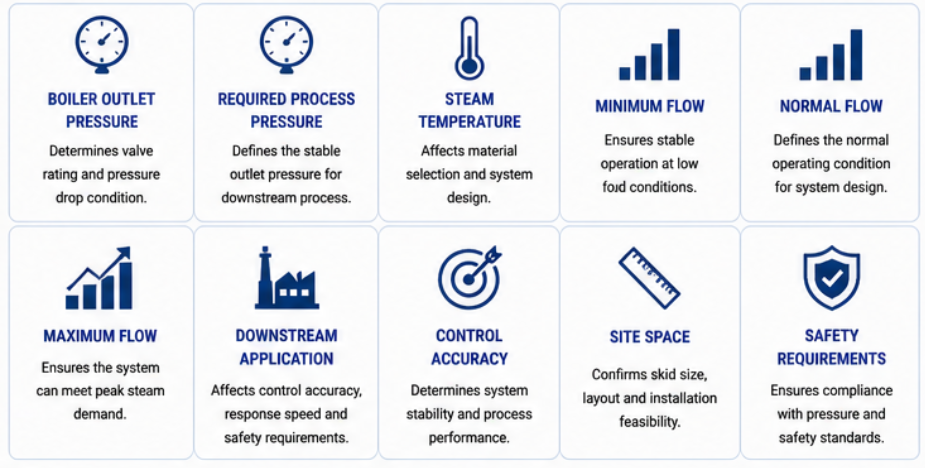
Key Steam Data For Boiler Room Projects
| Required Data | Why It Matters |
|---|---|
| Boiler Outlet Pressure | Determines pressure reducing valve rating and pressure drop condition. |
| Required Process Pressure | Defines the stable outlet pressure required by downstream equipment. |
| Steam Temperature | Affects material selection, insulation, and desuperheating requirement. |
| Steam Flow Range | Helps ensure stable operation at minimum, normal, and peak load. |
| Downstream Application | Affects control accuracy, response speed, and safety requirements. |
2. Review The Main Components Of The Steam Control Skid
A skid-mounted steam control system should be reviewed as a complete package, not as a single valve. A typical boiler room steam control skid may include an inlet isolation valve, pressure reducing control valve, safety valve, pressure gauges, pressure transmitters, temperature sensors, drain valves, bypass line, control cabinet, piping, supports, and skid frame.
If superheated steam temperature also needs to be reduced, the skid may include a desuperheater, spray water control valve, spray water inlet, temperature feedback loop, and downstream temperature sensor. The pressure control section and temperature control section should be designed together to avoid unstable operation.
Buyers should check whether the supplier’s scope includes all necessary components, instruments, wiring, testing, and documents. A low quotation may exclude important parts and create unexpected costs during installation or commissioning.
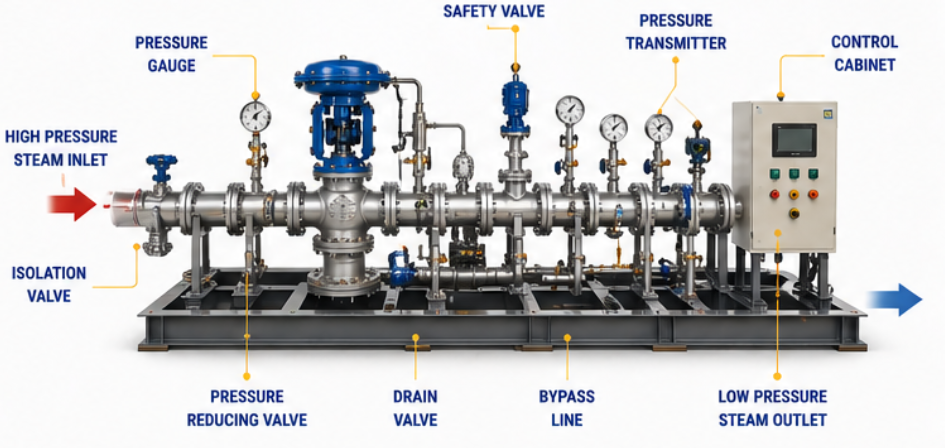
Common Components In A Boiler Room Steam Control Skid
| Component | Function |
|---|---|
| Pressure Reducing Valve | Reduces boiler steam pressure to the required process pressure. |
| Safety Valve | Protects downstream equipment from overpressure. |
| Pressure Transmitter | Provides feedback for automatic pressure control and monitoring. |
| Drain Valve | Removes condensate and helps prevent water hammer. |
| Control Cabinet | Supports local control, alarms, signal output, and automation interface. |
3. Choose The Right Control Valve, Actuator, And Instruments
The control valve is the core of the steam control skid. It must be sized according to inlet pressure, outlet pressure, steam flow range, pressure drop, steam temperature, and control accuracy. Selecting the valve only by pipe size is a common mistake in boiler room projects.
If the valve is oversized, it may operate at a very small opening and cause pressure hunting. If the valve is undersized, it may not supply enough steam during peak load. If the trim is not suitable for high pressure drop, the system may produce noise, vibration, erosion, and frequent maintenance problems.
Actuator type, positioner, signal interface, and fail-safe position should also be confirmed. For automated boiler rooms, the steam control skid may need to connect with PLC, DCS, or building management systems.
Control Items Buyers Should Check
Control valve size and calculated Cv value
Valve pressure class and temperature rating
Valve trim type and low-noise requirement
Actuator type: pneumatic, electric, or electro-pneumatic
Positioner and control signal compatibility
Pressure transmitter accuracy and installation position
Local control, remote monitoring, and alarm output
Fail-close, fail-open, or fail-last safety position
Practical Tip
For boiler room steam control, the best valve is not always the largest one. It should be correctly sized for minimum, normal, and maximum steam demand, with stable control across the full operating range.
4. Check Skid Layout, Drainage, And Maintenance Access
Boiler rooms often have limited installation space. This makes skid layout very important. Buyers should confirm skid dimensions, inlet and outlet direction, pipe connection standard, control cabinet position, lifting points, foundation requirements, and maintenance access before fabrication begins.
Steam systems also require proper drainage. Condensate accumulation can cause water hammer, vibration, valve damage, and unstable operation. The skid should include suitable drain points, vent points, pipe slope consideration, and enough space for inspection and maintenance.
A well-designed skid should allow operators to access control valves, safety valves, pressure gauges, transmitters, drain valves, and control cabinet without difficult disassembly. Good maintenance access improves long-term reliability and reduces downtime.
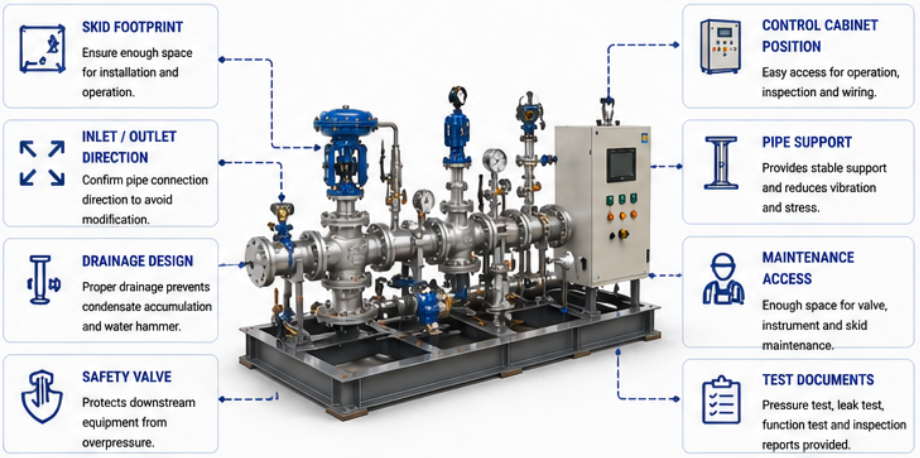
| Layout Item | Why It Matters |
|---|---|
| Skid Footprint | Ensures the system fits available boiler room space. |
| Inlet And Outlet Direction | Prevents site piping modification and installation delay. |
| Drainage Design | Helps prevent condensate accumulation and water hammer. |
| Control Cabinet Position | Supports safe operation, wiring, inspection, and maintenance. |
| Maintenance Space | Allows valve, actuator, instrument, and safety device maintenance. |
5. Confirm Testing, Documents, And Delivery Scope
One major advantage of a skid-mounted steam control system is that much of the assembly and inspection can be completed before shipment. Buyers should confirm whether the supplier will provide pressure test, leak test, functional inspection, instrument check, control cabinet inspection, and final visual inspection.
The final document package should include general arrangement drawing, P&ID, component list, valve data sheets, instrument data sheets, test reports, wiring details when applicable, operation manual, packing information, and spare parts list when required.
For overseas boiler room projects, clear documents and pre-shipment inspection records help reduce installation uncertainty and make communication easier between the buyer, contractor, installer, and end user.
Final Procurement Checklist
Confirm boiler outlet steam pressure and temperature.
Confirm required downstream pressure and steam flow range.
Review control valve sizing, trim, actuator, and positioner.
Check pressure transmitter, safety valve, drain, and vent arrangement.
Confirm skid layout, inlet/outlet direction, and available space.
Review control cabinet, alarm, and signal interface requirements.
Define pressure test, leak test, and functional inspection requirements.
Request drawings, data sheets, test reports, and operation manual.
Conclusion
Selecting a skid-mounted steam control system for boiler rooms requires a complete review of steam parameters, downstream pressure requirements, control valve sizing, instrumentation, safety protection, drainage, layout, testing, and documentation. A good system should provide stable steam pressure, safe operation, easy maintenance, and reliable long-term performance.
For project buyers, the best approach is to provide complete working conditions and work with a supplier that can design the steam control skid as a complete engineered package rather than a simple valve assembly.
FAQ
What is a skid-mounted steam control system?
It is a pre-assembled modular system that integrates valves, instruments, piping, control cabinet, safety devices, and skid frame for steam pressure control.
Why is it suitable for boiler rooms?
It reduces site installation work, improves factory quality control, saves space, and provides a more organized steam control solution.
What information is needed before quotation?
Buyers should provide boiler outlet pressure, required outlet pressure, steam temperature, flow range, pipe size, site layout, control requirements, and safety requirements.
Should the skid include a control cabinet?
If automatic control, alarms, local display, or remote monitoring are required, a control cabinet or signal interface should be included in the scope.
Need A Skid-Mounted Steam Control System For Your Boiler Room?
Send us your boiler steam pressure, outlet pressure target, steam flow range, site layout, and control requirements. Our engineering team can help you review the working conditions and provide a suitable skid-mounted steam control solution.
Get Quote Contact Us