



Gas Metering And Regulating Skid For Natural Gas Stations
2026-05-22 13:441. Why Natural Gas Stations Need Integrated Metering And Regulation
A natural gas station must deliver gas at the correct pressure and flow rate while ensuring accurate measurement and safe operation. If the pressure regulation is unstable, downstream users may experience pressure fluctuation, burner instability, equipment alarms, or process interruption. If the metering section is not properly selected, gas consumption data may become inaccurate.
A skid-mounted gas metering and regulating system allows the main functional sections to be pre-engineered, assembled, tested, and delivered as one complete package. This can reduce site installation work, improve factory quality control, and make future operation and maintenance easier.
It is commonly used for city gas stations, industrial natural gas supply stations, LNG satellite stations, boiler fuel gas stations, power plants, chemical facilities, industrial parks, and commercial gas distribution projects.
Typical Application Scenarios
Natural gas pressure regulating stations
City gas distribution and industrial gas supply stations
LNG satellite station outlet regulation and metering
Gas supply systems for industrial boiler rooms
Power plant and chemical plant gas utility systems
Industrial park centralized gas supply projects
2. Key Parameters Needed Before Skid Design
Before quoting or designing a gas metering and regulating skid for a natural gas station, the supplier needs complete working condition data. The most important information includes gas medium, inlet pressure range, required outlet pressure, maximum flow, normal flow, minimum flow, gas temperature, metering accuracy requirement, installation environment, and signal output requirements.
Flow range is especially important because a natural gas station may operate under different loads during peak usage, normal operation, and low-demand periods. The regulator must maintain stable outlet pressure, and the flow meter must still measure accurately across the required operating range.
If the data is incomplete, the skid may be oversized, undersized, difficult to maintain, or unable to meet the required accuracy and pressure stability.
Natural Gas Station Skid Data Checklist
| Required Data | Why It Matters |
|---|---|
| Gas Medium | Confirms material, sealing, filtration, metering method, and safety design. |
| Inlet Pressure Range | Determines pressure class, regulator configuration, and safety protection. |
| Outlet Pressure Requirement | Defines the required pressure for downstream gas users or process equipment. |
| Flow Range | Ensures stable regulation and accurate metering at minimum, normal, and peak flow. |
| Metering Accuracy | Affects flow meter type, calibration requirement, and data reliability. |
3. Main Components Of A Gas Metering And Regulating Skid
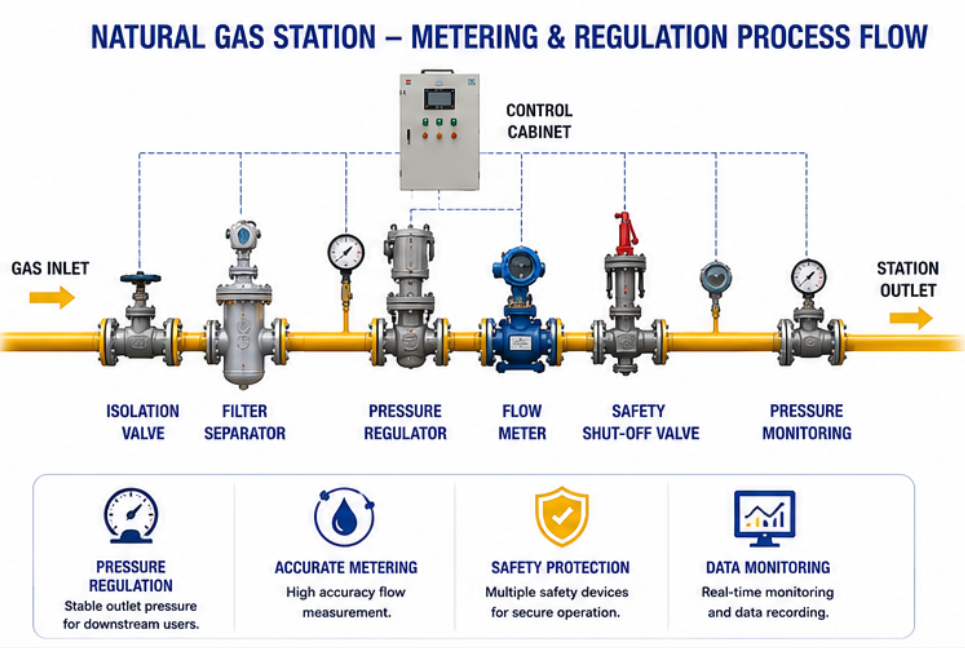
A gas metering and regulating skid for natural gas stations usually includes inlet isolation valve, filter separator, pressure regulator, flow meter, pressure gauges, pressure transmitters, temperature sensor, safety shut-off valve, relief valve, vent line, control cabinet, piping, and skid-mounted steel frame.
The filtration section removes particles and liquid impurities before gas enters the regulator and flow meter. The pressure regulating section stabilizes downstream pressure. The metering section measures gas flow for process monitoring, energy management, billing reference, or station operation data.
Depending on project requirements, the skid may also include dual-line design, one-duty-one-standby configuration, monitor regulator, ultrasonic flow meter, turbine flow meter, flow computer, pressure and temperature compensation, SCADA interface, or remote monitoring module.
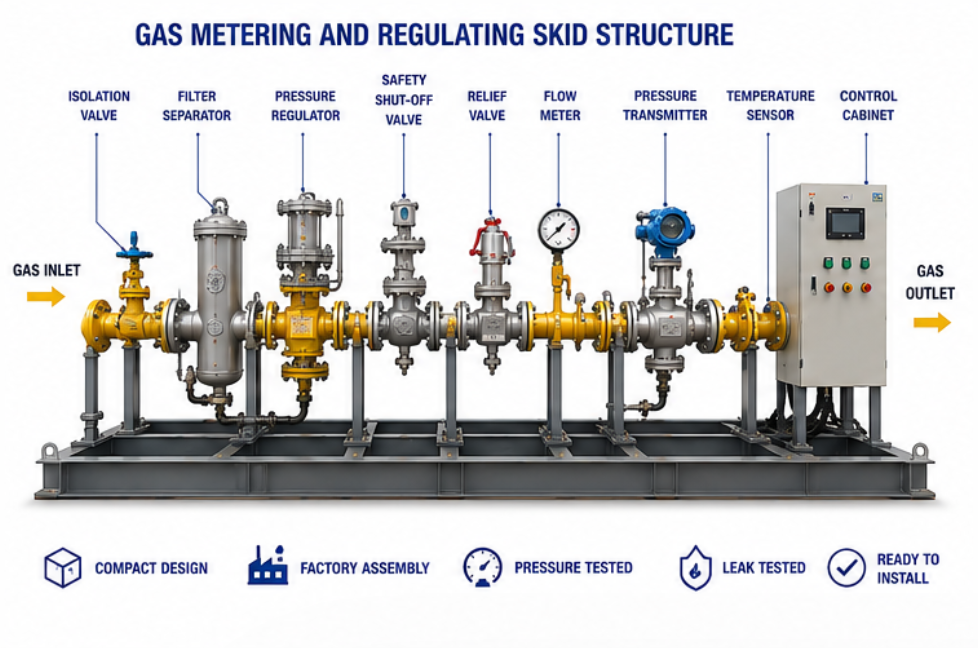
| Component | Function |
|---|---|
| Filter Separator | Removes dust, rust, liquid droplets, and impurities from natural gas. |
| Pressure Regulator | Reduces and stabilizes gas pressure for downstream users. |
| Flow Meter | Measures natural gas flow for monitoring, billing, or energy management. |
| Safety Shut-Off Valve | Cuts off gas supply under abnormal pressure or emergency conditions. |
| Control Cabinet | Supports local display, alarms, signal output, and remote monitoring. |
4. Metering Accuracy, Safety Protection, And Control Requirements
For natural gas stations, metering accuracy should be confirmed based on the application. If the skid is used for internal process monitoring, the accuracy requirement may be different from custody transfer or billing-related measurement. Buyers should confirm whether the system needs calibration certificates, flow computer, pressure compensation, temperature compensation, or specific communication protocol.
Safety protection is also critical. The skid should be designed to respond to overpressure, underpressure, filter blockage, regulator failure, abnormal flow, or emergency shutdown requirements. Common protection devices include safety shut-off valve, relief valve, monitor regulator, pressure transmitter, gas leak detector, and emergency shut-off valve.
If the station requires automation, the supplier should confirm signal output, alarm logic, control cabinet configuration, SCADA or PLC interface, and remote monitoring functions before quotation.
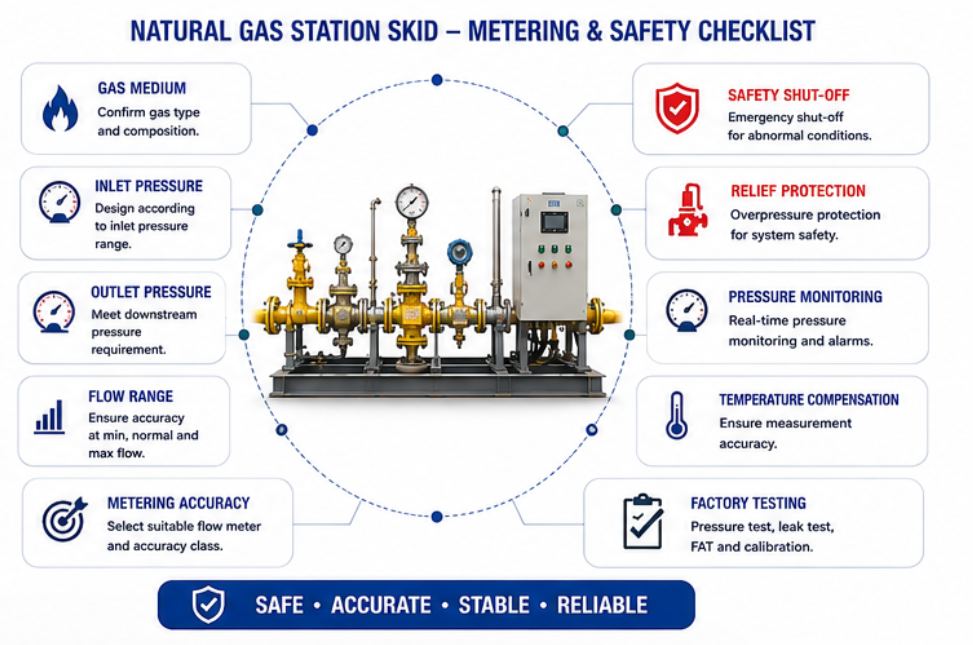
Safety And Metering Checklist
Confirm flow meter type and accuracy requirement.
Check upstream and downstream straight pipe requirements.
Confirm pressure and temperature compensation needs.
Review safety shut-off valve and relief protection configuration.
Check regulator failure protection and monitor regulator requirement.
Confirm local display, alarm output, and remote signal interface.
Review calibration certificate and test report requirements.
Confirm FAT, pressure test, leak test, and final documentation scope.
5. Why Skid-Mounted Design Is Suitable For Natural Gas Stations
A skid-mounted design is suitable for natural gas stations because it integrates multiple functional modules into a compact and organized package. Compared with site assembly, the skid can be pre-designed, pre-fabricated, inspected, and tested in the factory before shipment.
This helps reduce site welding, installation errors, missing components, and commissioning delays. It also allows buyers to review drawings, component lists, test reports, final photos, and packing details before delivery.
For natural gas station projects, a well-designed skid should provide stable pressure, accurate metering, safe operation, convenient maintenance, and reliable long-term performance.
Practical Tip
When comparing natural gas metering and regulating skid quotations, do not only compare the final price. Check metering accuracy, regulator configuration, safety devices, calibration documents, testing scope, and control system integration.
Final Buyer Checklist
Provide gas medium, pressure range, flow range, and temperature data.
Confirm metering purpose and required accuracy class.
Review regulator type, safety shut-off, and relief protection.
Check filter separator and maintenance access.
Confirm flow meter signal output and communication interface.
Review skid footprint, inlet/outlet direction, and installation environment.
Request calibration certificate, FAT report, pressure test, and leak test records.
Confirm final P&ID, GA drawing, manuals, and packing documents.
Conclusion
A gas metering and regulating skid for natural gas stations should be designed according to real gas conditions, station flow demand, pressure regulation requirements, metering accuracy, safety logic, control system, and site layout. It is not only a gas regulator package, but a complete station-side gas control and measurement solution.
For industrial buyers, the safest approach is to provide complete project data and work with a supplier that can support engineering design, component selection, factory assembly, testing, documentation, and delivery as one integrated skid-mounted system.
FAQ
What is a gas metering and regulating skid for natural gas stations?
It is a skid-mounted system used to filter, regulate, measure, monitor, and protect natural gas flow before gas enters downstream users or station outlet pipelines.
What information is needed before quotation?
Buyers should provide gas medium, inlet pressure range, outlet pressure, flow range, gas temperature, metering accuracy, station layout, and control requirements.
Which flow meter is suitable for natural gas stations?
The flow meter should be selected according to flow range, pressure, temperature, accuracy requirement, pressure loss, installation space, and whether the application is for monitoring or billing-related measurement.
Why choose a skid-mounted design?
A skid-mounted design reduces site installation work, improves factory quality control, supports pre-shipment testing, and makes the station system easier to inspect and maintain.
Need A Gas Metering And Regulating Skid For Your Natural Gas Station?
Send us your gas medium, inlet pressure, outlet pressure, flow range, metering accuracy requirement, and station layout. Our engineering team can help you review the working conditions and provide a suitable gas metering and regulating skid solution.
Get Quote Contact UsRelated product and article resources
For procurement comparison and technical evaluation, readers can continue with these related product pages and supporting articles.
- Products
- Product catalog
- Contact the sales team
- Contact us
- 3D Printing in Skid Component Prototyping
- 7 Strategic Advantages of Mature LNG Skid-Mounted Stations Revolutionizing Energy Infrastructure
- A Look Inside Shenqi's Factory: Quality Control in Skid Module Manufacturing
- Advantages of GAS PRESSURE REGULATING SKIDS