



Why Steam Pressure Is Stable At Boiler But Unstable After PRV
2026-06-27 21:43Need To Stabilize Steam Pressure After PRV?
Send us your boiler pressure, PRV inlet pressure, PRV outlet pressure, steam temperature, minimum / normal / maximum steam flow, downstream users, pressure trend, strainer condition, drainage layout, and existing PRV or skid photos. Our engineering team can help review whether a steam pressure reducing skid solution is suitable for your project.
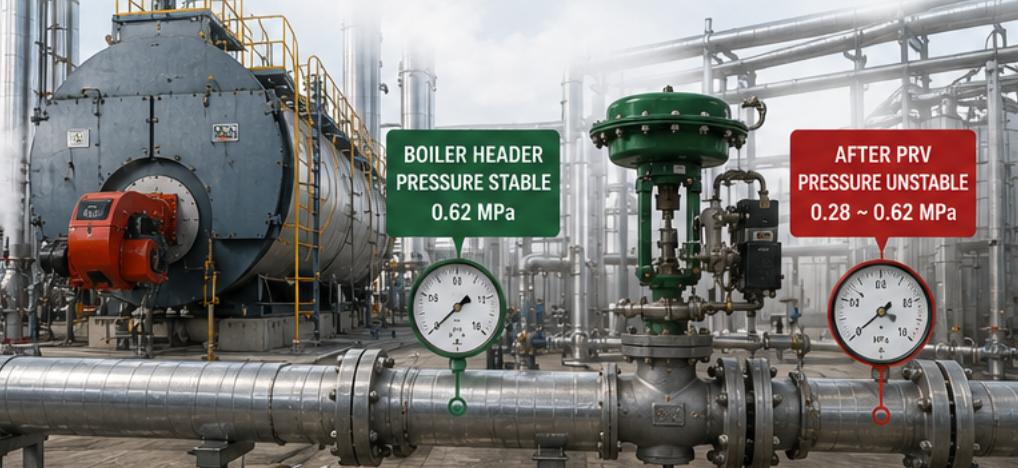
1. Why Boiler Pressure Can Be Stable While PRV Outlet Pressure Is Unstable
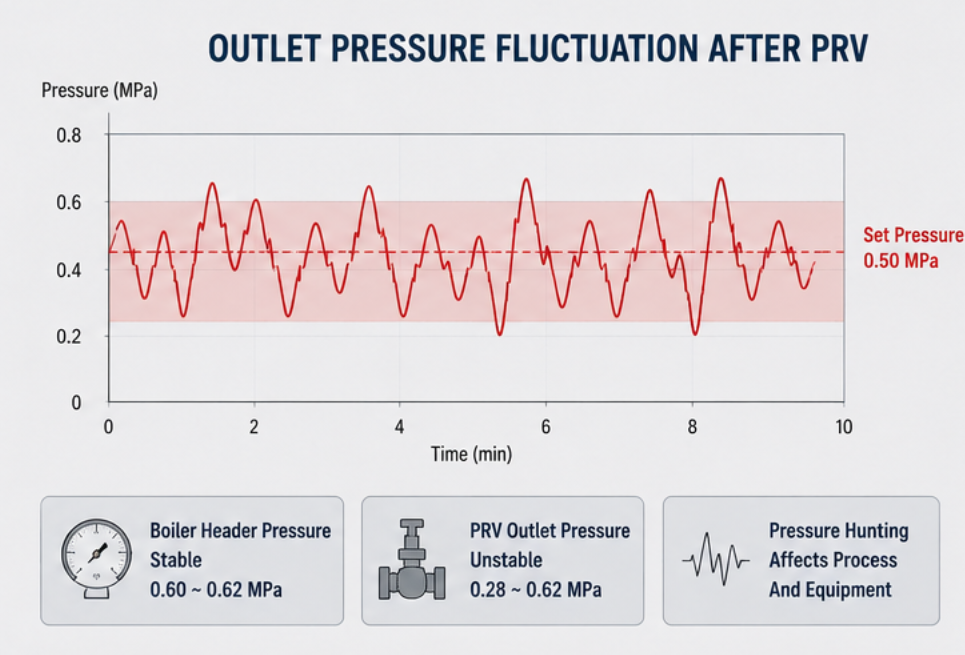
The boiler or steam header may provide stable high-pressure steam, but the pressure reducing valve must control a lower downstream pressure under changing flow conditions. If the PRV is not sized correctly, if the pressure feedback is unstable, or if downstream demand changes quickly, the outlet pressure may fluctuate even when the upstream boiler pressure remains stable.
This problem is common in boiler rooms, production heating systems, process steam lines, heat exchangers, drying lines, food processing plants, textile factories, chemical plants, pharmaceutical facilities, and industrial utility stations.
The key point is to compare pressure at different locations: boiler outlet, steam header, PRV inlet, PRV outlet, downstream branch line, and final equipment inlet. This helps determine whether the instability starts at the pressure reducing station or after the downstream distribution network.
Common Symptoms
Boiler pressure gauge remains stable, but PRV outlet pressure keeps rising and falling.
Steam pressure after the reducing valve hunts during low-load operation.
Downstream equipment cannot maintain stable process temperature.
Pressure reducing valve actuator moves frequently.
Pressure becomes unstable when production lines start or stop.
Noise, vibration, or water hammer appears near the reducing station.
2. Main Causes Of Unstable Pressure After PRV
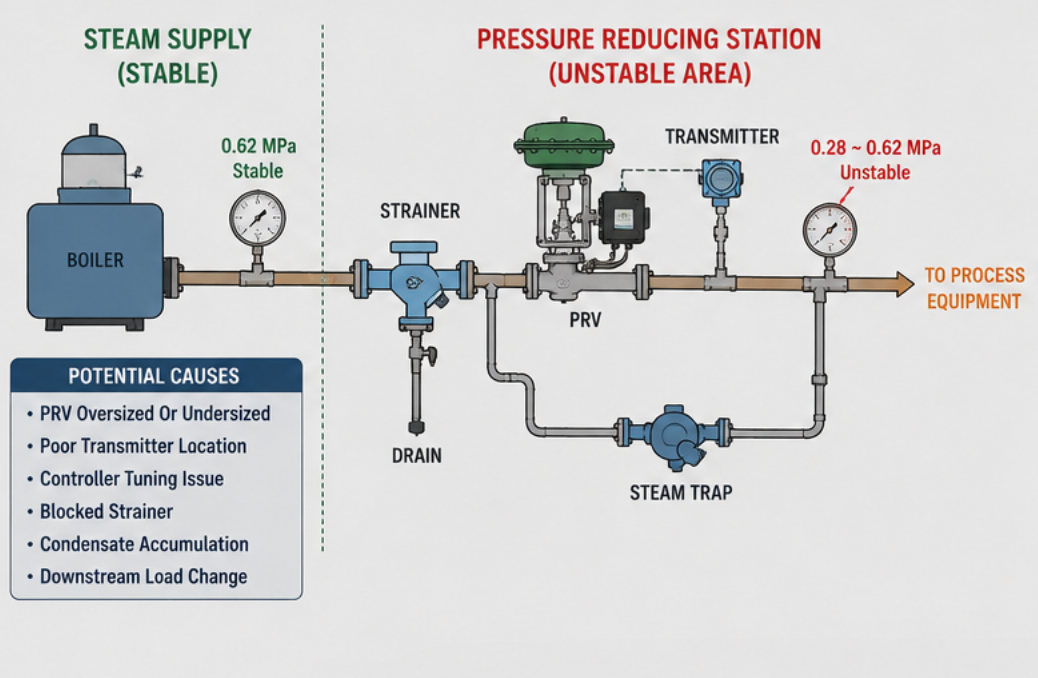
If boiler pressure is stable but pressure after the PRV is unstable, the issue is usually related to pressure reduction, control feedback, flow range, downstream steam demand, or mechanical restrictions around the reducing station.
Troubleshooting Table
| Possible Cause | Typical Result | What To Check |
|---|---|---|
| Oversized PRV | Outlet pressure hunts during low-flow operation. | Minimum, normal, and maximum steam flow range. |
| Undersized PRV | Outlet pressure drops during peak steam demand. | Peak load and downstream production demand. |
| Poor Pressure Transmitter Location | Controller receives unstable or delayed feedback. | Distance from PRV outlet, pipe turbulence, and measurement point. |
| Blocked Strainer | Steam flow is restricted before the reducing valve. | Strainer screen, dirt, rust, scale, and differential pressure. |
| Condensate Accumulation | Pressure fluctuation, vibration, and water hammer risk. | Steam traps, drain valves, pipe slope, and low points. |
| Downstream Load Change | Pressure becomes unstable when users start or stop. | Production sequence and total steam demand fluctuation. |
3. Check Whether The PRV Matches The Real Flow Range
A pressure reducing valve should not be selected only by pipe size. It must match actual steam flow. If the valve is too large, it may not control smoothly at low flow. If it is too small, it may fail to maintain outlet pressure during peak demand.
Many factories experience unstable pressure after PRV because the system was designed for future expansion, but current steam demand is much lower than the design flow. In other cases, factory expansion increases steam demand beyond the original valve capacity.
Flow Data To Prepare
Minimum steam flow during low-load operation.
Normal steam flow during regular production.
Maximum steam flow during peak production demand.
Startup steam demand when equipment is cold.
Future expansion flow if reserved capacity is required.
Required outlet pressure under each operating condition.
4. Review Pressure Feedback Location And Control Logic
Even if the PRV size is correct, poor pressure feedback can still make the outlet pressure unstable. If the pressure transmitter is too close to the valve outlet, it may read turbulent flow instead of stable downstream pressure. If the transmitter is too far away, the controller may respond too late.
Control logic also matters. Aggressive controller tuning may cause the valve to overreact. Slow or poorly matched actuator response may also cause pressure oscillation. For automatic steam pressure reducing systems, the valve, actuator, positioner, transmitter, and controller should be reviewed as one control loop.
Control Loop Checklist
Check pressure transmitter distance from the PRV outlet.
Compare local gauge reading with transmitter signal.
Review PID tuning and pressure control response.
Check actuator movement speed and positioner condition.
Confirm whether downstream pressure feedback is stable.
Review whether downstream users start and stop too suddenly.
5. Do Not Ignore Strainers, Condensate, And Downstream Piping
Unstable pressure after PRV may also be caused by mechanical problems around the steam line. A blocked strainer before the reducing valve can restrict steam flow. Condensate accumulation can disturb steam flow and cause vibration or water hammer. Small downstream pipe size can increase pressure loss and make outlet pressure unstable during high flow.
Before replacing the pressure reducing valve, operators should inspect strainers, drain valves, steam traps, pipe supports, downstream pipe size, and branch line arrangement. These issues are often found during commissioning or after production expansion.
Mechanical Inspection Checklist
Check strainer condition before the pressure reducing valve.
Inspect steam traps and drain valves near the PRV station.
Check pipe slope and low points for condensate accumulation.
Review downstream pipe diameter and pressure loss.
Check whether branch lines open and close suddenly.
Inspect vibration, pipe support, and water hammer risk near the PRV station.
6. How A Steam Pressure Reducing Skid Helps Stabilize PRV Outlet Pressure
A steam pressure reducing skid can integrate strainer, pressure reducing control valve, actuator, positioner, safety valve, pressure gauges, pressure transmitters, drain valves, bypass line, control cabinet, piping, supports, and skid-mounted frame into one engineered package.
Compared with separate site assembly, a skid-mounted system allows valve sizing, instrument location, drainage design, control logic, pipe layout, factory testing, and maintenance access to be reviewed together. If the system also needs outlet temperature control, a PRDS system with desuperheating may be more suitable.
Practical Tip
If boiler pressure is stable but pressure after the PRV is unstable, do not only adjust the boiler. Check PRV sizing, pressure feedback location, controller tuning, strainer blockage, condensate drainage, and downstream load changes together.
Engineering Review Checklist
Record boiler pressure, PRV inlet pressure, and PRV outlet pressure at the same time.
Confirm actual minimum, normal, and maximum steam flow.
Check whether the PRV is oversized or undersized.
Review pressure transmitter location and signal stability.
Check controller tuning, actuator response, and positioner condition.
Inspect strainer blockage and pressure loss.
Check condensate drainage and water hammer risk.
Consider a custom steam pressure reducing skid or PRDS system for stable operation.
Conclusion
Steam pressure may be stable at the boiler but unstable after the PRV because the issue is not always upstream steam supply. The real cause may be incorrect PRV sizing, unstable pressure feedback, poor control tuning, blocked strainer, condensate accumulation, downstream load changes, or poor pressure reducing station layout.
A properly designed steam pressure reducing skid can help stabilize PRV outlet pressure, improve control response, reduce hunting and vibration, improve drainage, protect downstream equipment, and support safer long-term steam system operation.
FAQ
Why is boiler pressure stable but pressure after PRV unstable?
Because the problem may be located at the pressure reducing valve, control loop, strainer, condensate drainage, or downstream pipe network, not at the boiler itself.
Can a wrong PRV size cause unstable outlet pressure?
Yes. An oversized PRV may hunt at low flow, while an undersized PRV may fail to hold pressure during peak demand.
Should the pressure transmitter location be checked?
Yes. Poor transmitter location may provide unstable or delayed feedback, causing the control valve to overreact and outlet pressure to fluctuate.
When is a steam pressure reducing skid needed?
A skid-mounted system is useful when the plant needs stable pressure reduction, integrated instruments, proper drainage, safety protection, factory testing, and easier installation.
Need Help With Unstable Steam Pressure After PRV?
Send us your boiler pressure, PRV inlet and outlet pressure, steam flow range, pressure trend, valve data, transmitter location, drainage condition, and site layout. Our engineering team can help review the working conditions and provide a suitable steam pressure reducing skid solution.
Get Quote Contact UsRelated Product Paths For This Project
Why Steam Pressure Is Stable At Boiler But Unstable After PRV should connect the troubleshooting topic with Shenqi's real equipment categories. For gas pressure, steam pressure reducing, PRDS, skid module, valve, and prefabricated pipeline projects, buyers usually need to compare the fault symptom with the full system scope before requesting a quotation. The related pages below help the engineering team move from diagnosis to product selection without leaving the site.
- Gas Pressure Regulating Skid
- Temperature and Pressure Reducing Device
- Prefabricated Pipeline
- Skid Module
- Pressure Vessel
- Accessories
- Valves
- Contact Shenqi Machinery
For a project specific review, prepare inlet pressure, outlet pressure, flow range, medium, temperature, control accuracy, valve configuration, instrument requirement, site layout, and commissioning schedule before contacting Shenqi Machinery.