


Why Wet Steam Happens After Desuperheating And How To Avoid It
2026-06-30 15:54Need To Solve Wet Steam After Desuperheating?
Send us your inlet steam pressure, inlet temperature, outlet pressure, target outlet temperature, steam flow range, spray water pressure, spray water flow, nozzle type, temperature sensor location, downstream straight pipe length, and current wet steam symptoms. Our engineering team can help review whether your PRDS system or desuperheating skid needs optimization.
1. What Is Wet Steam After Desuperheating?
In a normal desuperheating process, spray water is injected into superheated steam and evaporates inside the steam line. The steam temperature drops to the required value, while the outlet steam remains dry enough for downstream use.
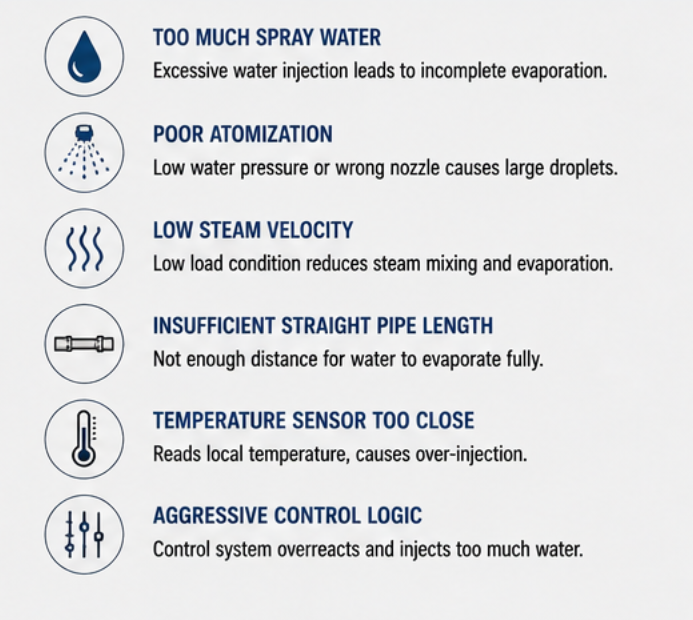
Wet steam happens when part of the injected water does not evaporate completely. Instead of fully mixing with steam, liquid droplets remain in the pipeline and travel downstream. This may happen because of too much spray water, poor atomization, low steam velocity, short mixing distance, incorrect sensor location, or unstable control logic.
Wet steam is not only a temperature problem. It is also a reliability and safety problem because liquid water in a steam line can damage valves, instruments, pipelines, and downstream equipment.
Common Signs Of Wet Steam
Water droplets or condensate appear after the desuperheater.
Downstream temperature fluctuates after spray water injection.
Water hammer, knocking noise, or pipe vibration appears.
Drain valves discharge more water than expected.
Control valve or downstream equipment shows erosion signs.
Heat exchanger or process equipment performance becomes unstable.
2. Main Causes Of Wet Steam After Desuperheating
Wet steam is usually caused by a mismatch between spray water injection and steam conditions. The desuperheater, nozzle, spray water pressure, steam velocity, temperature sensor, downstream straight pipe, and control system must work together. If one part is wrong, water may not evaporate fully.
Troubleshooting Table
| Possible Cause | Typical Result | What To Check |
|---|---|---|
| Too Much Spray Water | Water does not evaporate fully and travels downstream. | Spray water flow, control valve opening, and outlet temperature setpoint. |
| Poor Nozzle Atomization | Large droplets remain in the steam line. | Nozzle type, spray water pressure, blockage, scaling, and wear. |
| Low Steam Velocity | Steam cannot mix and evaporate water effectively. | Minimum steam flow and low-load operation condition. |
| Short Straight Pipe Length | Water reaches elbows or equipment before complete evaporation. | Available downstream mixing distance after desuperheater. |
| Temperature Sensor Too Close | Control system over-injects water due to incorrect feedback. | Distance between sensor and desuperheater outlet. |
| Aggressive Control Logic | Spray water valve reacts too strongly and causes overcooling. | PID settings, actuator response, and temperature control trend. |
3. Check Spray Water Flow And Atomization First
When wet steam appears after desuperheating, the first thing to check is spray water injection. If the spray water valve opens too much, if the nozzle is too large, or if the outlet temperature setpoint is too low, excessive water may enter the steam line.
Atomization is equally important. Fine droplets evaporate faster, while large droplets may remain as liquid water. Poor atomization can be caused by low spray water pressure, wrong nozzle type, nozzle blockage, scaling, wear, or unstable water supply pressure.
Spray Water And Nozzle Checklist
Spray water pressure before the control valve.
Spray water pressure at the nozzle inlet.
Spray water flow at minimum, normal, and maximum steam load.
Nozzle type, spray pattern, and atomization requirement.
Nozzle blockage, scaling, or wear condition.
Spray water quality, filtration, and maintenance records.
4. Straight Pipe Length And Sensor Location Are Critical
Spray water needs time and distance to evaporate. If the downstream straight pipe after the desuperheater is too short, liquid droplets may hit elbows, reducers, valves, or equipment before they evaporate fully. This is one of the main causes of wet steam, pipe erosion, and water hammer after desuperheating.
Temperature sensor location also affects wet steam risk. If the sensor is installed too close to the injection point, it may measure local temperature before full mixing. The controller may then over-inject water, causing wet steam even though the displayed temperature looks close to the setpoint.
Layout Checklist
Available straight pipe length after the desuperheater.
Distance between injection point and temperature sensor.
Location of elbows, reducers, valves, and branch lines after injection.
Drain points after desuperheating section.
Whether downstream equipment can tolerate wet steam risk.
Whether the temperature sensor reads fully mixed outlet steam.
5. Low-Load Operation Can Increase Wet Steam Risk
Many desuperheating systems are designed for normal or high steam flow, but actual operation may often happen at low load. At low steam flow, steam velocity is lower, mixing becomes weaker, and water droplets may not evaporate fast enough.
If the PRDS system cannot control spray water accurately at low load, over-injection can happen. This can create wet steam even when the system performs well at normal flow. For this reason, minimum steam flow should always be provided before selecting a desuperheater or PRDS skid.
Low-Load Review Checklist
Minimum steam flow during real operation.
Steam velocity at low-load condition.
Minimum controllable spray water flow.
Spray water valve turndown performance.
Nozzle performance under low water flow.
Temperature stability during low-load operation.
6. How A Proper PRDS Skid Helps Avoid Wet Steam
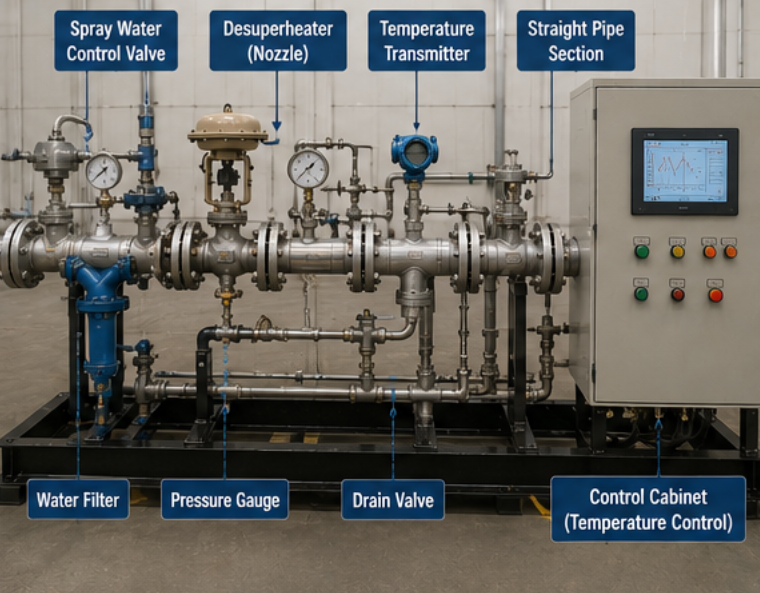
A well-designed PRDS skid does not only include a pressure reducing valve and a desuperheater. It should integrate pressure reducing control valve, desuperheater, spray water control valve, spray water filter, pressure gauges, temperature sensors, drain valves, safety valve, control cabinet, piping, supports, and skid-mounted frame.
The design should review steam flow range, spray water pressure, nozzle atomization, mixing distance, sensor location, drainage, and control logic together. This helps avoid over-injection, incomplete evaporation, wet steam, and downstream water damage.
Practical Tip
If wet steam happens after desuperheating, do not only reduce the spray water valve opening. Check spray water flow, nozzle atomization, steam velocity, straight pipe length, temperature sensor location, drainage, and control logic together.
Engineering Review Checklist
Confirm inlet steam pressure and temperature.
Confirm outlet pressure and outlet temperature target.
Review minimum, normal, and maximum steam flow.
Check spray water pressure, flow, temperature, and quality.
Review nozzle type, atomization quality, and blockage risk.
Check straight pipe length and temperature sensor location.
Review drainage arrangement after desuperheating.
Consider a custom PRDS skid for stable dry steam supply.
Conclusion
Wet steam after desuperheating happens when injected spray water does not evaporate fully. Common causes include excessive spray water, poor nozzle atomization, low steam velocity, short straight pipe length, wrong temperature sensor location, aggressive control logic, poor drainage, and unsuitable PRDS skid design.
A properly designed PRDS system can help control outlet steam temperature while avoiding wet steam, water carryover, pipe erosion, water hammer, and downstream equipment damage.
FAQ
Why does wet steam happen after desuperheating?
Wet steam happens when spray water does not evaporate fully after injection. It may be caused by excessive water, poor atomization, low steam velocity, short mixing distance, or wrong sensor location.
Can too much spray water cause wet steam?
Yes. If the spray water flow is higher than what the steam can absorb and evaporate, liquid droplets may remain in the steam line and cause wet steam.
Why is straight pipe length important?
Straight pipe length gives spray water droplets time to evaporate and mix with steam. If the distance is too short, water may reach downstream bends, valves, or equipment.
How can wet steam be avoided?
Wet steam can be reduced by correct spray water control, good nozzle atomization, enough mixing distance, proper sensor location, suitable drainage, and a properly designed PRDS skid.
Need Help Avoiding Wet Steam After Desuperheating?
Send us your steam pressure, temperature, flow range, outlet temperature target, spray water data, nozzle condition, sensor location, and pipe layout. Our engineering team can help review the working conditions and provide a suitable PRDS skid solution.
Get Quote Contact UsRelated Product Paths For This Project
Why Wet Steam Happens After Desuperheating And How To Avoid It should connect the troubleshooting topic with Shenqi's real equipment categories. For gas pressure, steam pressure reducing, PRDS, skid module, valve, and prefabricated pipeline projects, buyers usually need to compare the fault symptom with the full system scope before requesting a quotation. The related pages below help the engineering team move from diagnosis to product selection without leaving the site.
- Gas Pressure Regulating Skid
- Temperature and Pressure Reducing Device
- Prefabricated Pipeline
- Skid Module
- Pressure Vessel
- Accessories
- Valves
- Contact Shenqi Machinery
For a project specific review, prepare inlet pressure, outlet pressure, flow range, medium, temperature, control accuracy, valve configuration, instrument requirement, site layout, and commissioning schedule before contacting Shenqi Machinery.